Posts

Showing posts with the label Anthem Stamp

Dominican Republic 2016 National Anthem 50th Anniversary

Image
On 7 June 1897, the Congress of the Dominican Republin passed an act adopting "Himno Nacional" with the original music and revised lyrics as the country's official national anthem; however, then President Ulises Heureaux (1846-1899) vetoed the act because the lyric's author, Prud’Homme, was an opponent of the president and his administration. In 1899, Heureaux was assassinated, and the political disorder that ensued prevented the national anthem's legal adoption until 30 May 1934 when "Himno Nacional" was officially adopted and signed into law. The Spanish name of the Dominican Republic, "República Dominicana", is never used in the anthem's official Spanish lyrics nor is the denonym for Dominicans, "dominicanos". Rather, the indigenous word for the island Hispaniola, "Quisqueya", is used twice and its derivative denonym, "quisqueyanos", is used once. However, research later shows that these ...

Anthem Postmark from Ettelbruck

Image
Ettelbruck  is a commune with city status in central Luxembourg, with a population of approximately 7,500. As of 2005, the town of Ettelbruck itself, which lies in the east of the commune, has a population of 6,191. The town of Warken and Grentzingen are also within the commune. Until 1850, both Erpeldange Schieren were part of the Ettelbruck commune as well, but both towns were detached from Ettelbruck by law on 1 July 1850. This first day cover was issued on June 13, 1989 with special FDC postmark to commemmorate the 12th Anniversary of the Premiere Execution d Hymne National.

Anthem Covers with Special Postmarks

Image

South African Anthem and Inauguration on Stamp

Image
Nkosi Sikelel' iAfrika was composed in the year 1897 by Enoch Sontonga, a Methodist school teacher. It was originally sung as a church hymn but later became an act of political defiance against the apartheid government. Die Stem van Suid-Afrika is a poem written by C.J. Langenhoven in 1918 and was set to music by the Reverend Marthinus Lourens de Villiers in 1921.[2] Die Stem was the co-national anthem[3] with God Save the King/Queen from 1936 to 1957, when it became the sole national anthem until 1995. The South African government adopted both songs as national anthems from the year 1994, when they were performed at Nelson Mandela's inauguration.[4] They were merged in 1997 to form the current anthem. The new English lyrics were adapted from the last four lines of the first stanza of The Call of South Africa (the English version of Die Stem), and were modified to reflect hope in post-apartheid South African society.

Guatemalan Anthem Lyricist on Stamps

Image
Written in response to a contest calling for a national anthem to be adopted, the first ever playing of the winning entry took place during a lyric-literary meeting taking place at the Colon Theater, the night of Sunday 14 March 1897, as one of the main events of the Central American Exposition, and the author of the music was decorated with a gold medal and honor diploma. (Ovalle had been known previously for setting to music "Himno Popular" (The People's Anthem) by the poet Ramón P. Molina. It is unclear whether the music used for Ovalle's work was the same as the music that was submitted for the national anthem competition.) The author of the lyrics, however, was submitted anonymously, it was not until 1911, when it was discovered that the author was the Cuban poet Jose Joaquin Palma, who on his deathbed was honored with a silver wreath placed on his head, while outside the public and the bands sang the Himno Nacional. The original lyrics were modified slight...

Isle of Man Anthem on Europa Stamps

Image
This is a Europa stamp featuring the lyrics of the anthem of the Isle of Man on the tab.  This set is compose of two stamps values of  25p and 30p.  Previously the anthem of the Isle of Man was already feature here .  The anthem composer and lyricist were shown in the stamp.  A Europa stamps are special stamps issued by European postal administrations under the aegis of PostEurop and which have Europe as their central theme. Europa stamps should underline cooperation in the domain of posts, particularly as regards the promotion of philately and contribute to making the public aware of common roots, culture and history of Europe and common goals." In 2002, more than 50 European countries and territories issued Europa Stamps. The first issue dates from 1956 with 6 countries participating. From 1993 all the stamps have "Europa" inserted into the design in small print. For the new millennium in 2000, the common design once more replaced the common theme. T...

Yugoslavian Anthem Lyrics and Score on FDC

Image
The National anthem of the Kingdom of Yugoslavia (Kingdom of Serbs, Croats and Slovenes 1918–1929) was created in December 1918 from the national anthems of the Kingdom's main three constituent historical provinces: Croatia, Serbia and Slovenia. In those times the official authorities considered the three nations, Croats, Serbs and Slovenes as one nation with three names. The official language was thus called the Serbo-Croato-Slovene language. Although a law on the national anthem did not exist, the anthems of all three South Slavic nations were unified into a single anthem of the Kingdom. It started with a few measures from the Serbian anthem "Bože pravde", continued with a few lines from the Croatian anthem "Lijepa naša domovino", which were in turn followed by a few lines from the traditional Slovenian anthem "Naprej zastava slave". The anthem finished with some lines from the Serbian anthem again. It was officially used between 1919 and 1941...

Ukraine Anthem Lyrics on Stamp

Image
"Shche ne vmerla Ukraina" ("Ukraine has not yet perished") is the national anthem of Ukraine again since 1992  Before its re-adaptation a concourse for a national anthem among three patriotic songs was taken place with one of the other songs being Za Ukrainu by Mykola Voronyi.    The lyrics constitute a slightly modified original first stanza of the patriotic poem written in 1862 by Pavlo Chubynsky, a prominent ethnographer from the region of Ukraine's capital, Kiev, and were influenced by the words and themes of Poland's national anthem,  Poland Is Not Yet Lost. In 1863, Mykhailo Verbytsky, a western Ukrainian composer and a Greek-Catholic priest composed music to accompany Chubynsky's text. The first choral performance of the piece was at the Ukraine Theatre in Lviv, in 1864. The song was first the national anthem of the Ukrainian People's Republic, Carpatho-Ukraine and later the independent post-Soviet Ukraine. The stamp above was issued t...

Sierra Leone National Anthem on Stamps

Image
Formerly a British colony, this west African nation adopted its national anthem, "High We Exalt Thee, Realm Of The Free", upon independence in 1961. The composer of the music, John Joseph Akar , was the first post independence Director of the Sierra Leone Broadcasting Service (SLBS) as well as the founder of the Sierra Leone national Dance Troupe, and the lyricist Clifford Nelson Fyle , was a professor at Fourah Bay College in Sierra Leone. John Joseph Akar (1927–1975) was a Sierra Leone-an of Lebanese descent entertainer, writer, and diplomat. He served as Sierra Leone-an Ambassador to the United States. Today, he is probably best known for composing the music of the Sierra Leone's National Anthem. Akar was born in the small town of Rotifunk, Moyamba District in the Southern P rovince of Sierra Leone, to an ethnic Sherbro mother and to a Lebanese father. Akar attended the E.U.B. primary school in Rotifunk, and proceeded to Albert Academy secondary school in Freetown. ...

Dr. Sun Yat Sen, Taiwan Anthem Writer

Image
Sun Yat-sen (12 November 1866 – 12 March 1925) was a Chinese revolutionary and president. As the foremost pioneer of Nationalist China, Sun is referred to as the "Father of the Nation" in the Republic of China (ROC), and the "forerunner of democratic revolution" in the People's Republic of China. Sun played an instrumental role in the overthrow of the Qing dynasty during the Xinhai Revolution. Sun was the first provisional president when the Republic of China was founded in 1912 and later co-founded the Kuomintang (KMT), serving as its first leader. Sun was a uniting figure in post-Imperial China, and remains unique among 20th century Chinese politicians for being widely revered amongst the people from both sides of the Taiwan Strait. Although Sun is considered one of the greatest leaders of modern China, his political lif e was one of constant struggle and frequent exile. After the success of the revolution, he quickly fell out of power in the newly founded Re...

New Zealand's Unofficial National Anthem on Stamps?

Image
New Zealand has honored Engelbert Humperdinck by releasing a stamp based on his song ‘Ten Guitars’. Engelbert released ‘Ten Guitars’ as a b-side in 1967. It was also on his debut album ‘Release Me’. However, despite originally be used as more filler than thriller the song took on a life of its own in New Zealand and is now considered the country's unofficial national anthem.    There was even a Facebook petition to have it made the national anthem. ‘Ten Guitars’ is said to be one of the most played songs at parties in New Zealand.The 60-cent ‘Ten Guitars’ stamp features in a set of Kiwiana stamps out now in New Zealand. Engelbert Humperdinck (born Arnold George Dorsey; 2 May 1936) is a British pop singer, best known for his hits including "Release Me (And Let Me Love Again)" and "After the Lovin'" as well as "The Last Waltz" ("The Last Waltz with You").   email: vincemd3069@gmail.com

The 20th Anniversary of the Restoration of State Independence of the Republic of Azerbaijan on Stamp and Souvenir Sheet

Image
Like other republics of the Soviet Union at the time, Azerbaijan had its own anthem, which was in use until shortly after the fall of the Soviet Union in 1991. Azerbaijan was originally given an anthem in 1944, but a slight change to the lyrics came in 1978 with the removal of Stalin's name and other minor changes. The composer of the anthem's melody also wrote the music for the current Azerbaijani national anthem in 1919 before Azerbaijan became part of the Soviet Union. On January 30, 1920, the Azerbaijan government announ ced a competition to create a national anthem, but in the result of the fall of Azerbaijan to the Soviet Union on April 28, 1920, the anthem was not adopted. On May 27, 1992, after the breakup of the Soviet Union, the "Azerbaijan Marsi," which was created in 1919 during the brief independence period, was approved as the State Anthem of the Republic of Azerbaijan . The composer of the anthem was Uzeyir Hajibeyov, the s...

Slovenian Anthem Lyrics on Stamps

Image
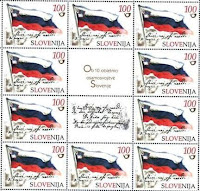
"Zdravljica" was written by France Prešeren , considered as Slovenia's national poet, as a drinking song (in his original manuscript, the layout of the words resemble a wine glass), but also was seen as politically charged piece when it was written in 1844 as it spoke of pan-Slavic nationalism, which was controversial in Austria-Hungary (which Slovenia was part of at the time). It was finally published in 1848, after revolutions in Austria-Hungary lifted the censorship. In 1905, Zdravljica was set to music for the first time, the entire poem had a choral composition composed for it by Stanko Premrl, and this was the composition chosen as the Slovenian anthem in September 1989. Six months later, it was specified that the seventh verse is the official anthem, and this remains to this day. The block above contains the flag and some of the lyrics of the Slovenian national anthem. It was issued on 2001 .

THE FDC COVER FOR SOKOL CONVENTION PRAGUE 1948 WITH CZECHOSLOVAK ANTHEM

Image
This cover was published in Czechoslovakia in 1948 for its 11th SOKOL Convention. "SOKOL" is a sport organization, Czechoslovak Sokol Community and Prague Sokol were played an important role by events around the foundation of the Czechoslovak Republic. This FDC includes 4 special overstamped stamps with the text:" PRAGUE 1948 Nationwide SOKOL Convention". On the cachet, we can see the words and music of Czechoslovak Anthem "Where is My Home" in Czech language. The size of the cover is 22 x 11 cm / 8.6 x 4.3 inches. The FDC Cover for SOKOL Convention Prague 1948 with Czechoslovak Anthem and for occasional stamps.

'O Canada' on the 2011 Canadian Flag Definitive Stamps Series

Image
The sheer number of places where the Canadian flag is found was the creative impetus to this stamp series. According to Liz Wong, Stamp Design Manager for the series, the challenge was to take a very common but much beloved image like the flag, an image people are familiar with seeing on a stamp, but approach it in a fresh new way and present the flag in ways in which it’s actually used. “The Canadian Pride series draws your attention to both the common – and uncommon – places the flag appears.” The five Permanent domestic stamps in this year’s issue demonstrate both personal and official appearances of the flag; on a traveller’s backpack, a hot air balloon, the Canadarm, and both a Canadian soldier’s and a search and rescue expert’s uniforms. The stylized “O” (for “O Canada”) not only acts as a symbol of the national anthem, it also serves as a means of focusing attention on the flag and its surroundings. Liz Wong adds that “by framing the visual with the “O” of “O Canada”, this stamp...

Iranian Anthem Composer, Ruhollah Khaleqi, on Stamp

Image
On July 11, 2011, Iran issued a stamp on musician and composer Ruhollah Khaleqi known for his composition of Iran’s former national anthem "O, Iran". The stamp, printed in commemoration of the musician, was unveiled during a ceremony held on the side section of Iran’s National Orchestra performance in the presence of Iranian tar virtuoso Hossein Alizadeh.Khaleqi was brought up in a family of music lovers. He was a student of celebrated composer and musician Ali-Naqi Vaziri.His other credits include several books on music under the titles “History of Iranian Music” and “A View on Iranian Music.” Rūhollāh Khāleqi (1906, Kerman, Iran – November 12, 1965, Salzburg, Austria) , also spelled as Khaleghi, was a prominent Iranian musician, composer, conductor and author. Ruhollah Khāleghi was born in Mahan, a small town near Kerman, in a musically minded family. He first became acquainted with the tar, but later started to learn to play the violin. As soon as Ali-Naqi Vaziri establ...

Galician Anthem Composer and Lyricist on a Special FDC Cancel

Image
Pascual Veiga Iglesias ( April 9 of 1842 - Madrid , July 12 of 1906 ) was a musician, musical director, organist and composer of the National Anthem of Galicia . Veiga started his musical studies as a child in the choir of the Cathedral Mindoniense. At thirteen he began to teach music theory and harmony in the chapel of the cathedral. In 1964 he moved to La Coruña and served as organist of the Church of Our Lady of the Field. I n 1865 he was appointed vice president of Section Music Society Youth Fraternity. His dedication to music led him to win a prize in 1877 with the Glee Club Bragantino. He left year later, and founded the Glee Club Corunna. In 1880 he was invited by the Society of Floral Games of Pontevedra , and premiered his most emblematic work, the Alborada Gallega. Two years later he founded El Nuevo Orfeon, which soon became known as el Orfeon Echo, and that continues today. In 1889 he founded the Choral Society called Corunna Number 4, a group that won the gold medal a...

The Anthem of Taiwan on Metered FDC

Image
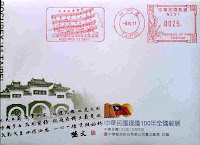
This is the First Day Cover of 2011 ROCUPEX Taipei Stamps Exhibition Meter Stamp from Formosa (Taiwan), Republic of China. The 2011 ROCUPEX Taipei Stamps Exhibition commemorates the 100th anniversary of the Republic (Oct 07-12,2011).    This FDC, issued on October 7, 2011 features the image of National Anthem of the Republic of China . This cover is a design error with 2 wrong Chinese characters in the National Anthem of the meter stamp. The special meter shows the score of the National anthem.   The anthem lyrics in traditional Chinese script is seen on the cachet. This FDC has a face value of 25 new Taiwan dollar.

Liberian Anthem Lyrics on an Unissued Souvenir Sheet

Image
Liberia, officially the Republic of Liberia, is a country on the west coast of Africa, bordered by Sierra Leone, Guinea, and Côte d'Ivoire. Liberia, which means "Land of the Free", was founded as an independent nation by free-born and formerly enslaved African Americans. Recently it has witnessed two civil wars, the Liberian Civil War (1989–1996), and the Second Liberian Civil War (1999–2003), that have displaced hundreds of thousands and destroyed its economy. The national anthem of Liberia, "All Hail, Liberia Hail" was composed by Olmstead Luca in 1869. The words to the anthem of this second oldest independent African nation were written by the nation's third president, Daniel Bashiel Warner, and adopted upon independence in 1847. Presumably, the anthem first had a different melody, as the current music was written in 1860. Above is an unissued souvenir sheet featuring the Liberian anthem lyrics.

Rota- Anthem of the Polish National-Territorial Region

Image
The Polish National-Territorial Region (Polish: Polski Kraj Narodowo-Terytorialny) was an autonomous region in Lithuania, self-proclaimed by the local Poles on 6 September 1990. The region included areas surrounding Vilnius, capital of Lithuania, where Poles formed the majority (60–90%). This Eastern part of Lithuania had been part of Poland (from 1922) before being attached to Lithuania under the Mutual Assistance Treaty with the Soviet Union in 1939. The autonomy region with capital in Naujoji Vilnia included 4,930 km² and population of 215,000 (66% of them Poles). The Polish autonomous movement was related to the Yedinstvo movement and had tacit support from Moscow (thus, when following the Act of the Re-Establishment of the State of Lithuania the Soviets applied a blockade against Lithuania, the areas of Eastern Lithuania with significant minority population were mostly spared of the blockade, with the aim of gaining minorities' support for Moscow). In the region, the Polish Re...