Posts

Showing posts with the label Stamp

The Rising Sun of Argentina as Described in the First Version of its Anthem

Image
It is still unknown who designed the coat of arms, but it is often mentioned that there were three men: Alvear, Monteagudo and Vieytes, but it is known that a few years before, President Bernardino Rivadavia asked the Peruvian Antonio Isidoro Castro to create an Argentine coat of arms, but the two schemes were never found.    The coat of arms is a figure, in which we find the following symbols: At the top is the famous sun symbol of Argentina, the gold-yellowed Sun of May, also found on the Flag of Argentina. The rising sun symbolizes the rising of Argentina, as described in the first version of the Argentine National Anthem : it says "Se levanta a la faz de la tierra una nueva y gloriosa nación," meaning "A new and glorious nation rises to the surface of earth." It must be noticed how the verb "rise" (and so in Spanish) can be used to describe the motion of the Sun.

A Unique Rizal Stamp

Image
I have quite a number of Jose Rizal stamps in my collection, but the 1941 apple-hued 2c Commonwealth Regular is one of a kind. This stamp features the young Rizal as rendered by the New York photographer Elaine Rawlinson . The image on this stamp was copied from a menu card which won a stamp design contest sponsored by the Asociacion Filateleca de Filipinas . The stamp cause quite a stir among keen philatelist who noticed that Rizal's hair was parted on the right instead of the usual left!    This is the only Rizal stamp which portrays his hair as such. This stamp also became the first stamp of a series of postage stamps bearing the inscription "United States of America- Commonwealth of the Philippines". This replaced the the 1935 Commonwealth overprint series and as the last of the pre-war issues. I acquired a few of the stamps bearing this inscription and these include the 1906 Jose Rizal PI-USA stamp - the first Jose Rizal stamp ever issued and the first ...

The Menara KL and other Observation Towers on Stamps

Image
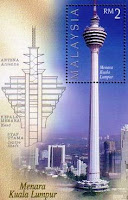
I have never visited the Tower of Juche , nor am I planning to visit the place. I also have no desire to cross the demilitarized zone between South Korea and North Korea, although I have contemplated the thought when I was there twice. But this tower interest me, because North Korea issued a stamp in the nineties with its flag and national anthem score featured on it. Various attempts to avail of this stamp was an exercise in futility. Until now, I still don't have the stamp, so I you have it, please email me or give me a call. I have however recently visited four observation Towers- the Coit Tower in San Francisco, California, the Menara Tower in Kuala Lumpur, the Macau Tower in China and the N Seoul Tower in South Korea. The Coit Tower is located in Pioneer Hill in San Francisco, California and built in 1933 at the bequest of socialite Lilly Hitchcock Coit. The art deco tower, made of unpainted reinforced concrete, was designed by architects Arthur Brown, Jr. and Henry ...

The National Anthem of Malaysia

Image
Before independence in 1957, each of the (then) eleven states of Malaysia had their own anthem (which they have retained to this day), but there was no unifying anthem for the whole country. When independence was approaching, Tunku Abdul Rahman , then the Chief Minister and Minister for Home Affairs (later Malaysia's first prime minister), led a committee to select a new anthem.    Hundreds were recieved, but none were deemed suitable. Finally, the anthem for the Malaysian state of Perak was considered, and the melody, due to its "traditional flavour" was selected to be the melody for the new anthem. In 1888 the Sultan of Perak was invited by Queen Victoria as a guest. When the Sultan's aide was asked what the anthem of Perak was, so that it could be played upon his formal arrival, the aide, not wanting to be embarrassed by saying that Perak did not have an anthem, perhaps giving the impression that his country was "backwards", proceeded to hum a favouri...

Georgi Dimitri and "Balgariyo Mila"

Image
Bulgaria, "Balgariyo Mila" (Dear Bulgaria) was the National anthem of Bulgaria in use from 1950-1964. The words were written by Nikola Furnadshiev, Mladen Issaev and Elisaveta Bagrjana and set to music by Georgi Zlatev-Tscherkin, Svetoslav Obretenov and Georgi Dimitri.   Once Communist rule was secured in Bulgaria, "Balgariyo mila" was introduced as the national anthem. Interestingly, the anthem was replaced in 1964 while the Communists were still in power. One of the composers of the music, Georgi Dimitrov (not to be confused with the Communist leader of the time with the same nam)  also wrote the previous anthem.   Georgi Dimitri (born June 18, 1882, Kovachevtsi, Bulg. — died July 2, 1949, near Moscow, Russia, U.S.S.R.) was a Bulgarian communist leader. He helped found the Bulgarian Communist Party in 1919. After leading a communist uprising in 1923 that provoked fierce govern ment reprisals, he was forced to live abroad and became head of the central Europ...

"The Wall of Steel", Taldir Jaffrenou ,Writer and Anthem Composer

Image
Francois Joseph-Claude Jaffrennou (March 15, 1879 - March 26, 1956) was a Breton language writer and editor. He was a Breton nationalist and a neo-druid bard. He is also known as François Taldir-Jaffrennou, since he also used the Druid name Taldir ("Wall of Steel"). He was one of the pioneers of the Breton autonomous movement. He composed the National anthem of Britanny . Breton nationalism is the nationalism of the traditional province of Brittany in France. Brittany is considered to be one of the six Celtic nations (along with Cornwall, Ireland, Wales, the Isle of Man and Scotland). Like the nationalism of many neighboring regions, Breton nationalism combines political as well as cultural aspects. The political aspirations of Breton nationalists include the desire to obtain the right to self-rule, whether within France or independently of it, and to acquire more power in the European Union, United Nations and other international bodies. Breton cultural nationalism include...

Unexpected Music Stamps on an Envelope

Image
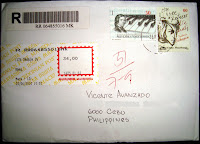
It is always a delight to receive mail from friends and sellers with your thematic stamp posted on the envelope. I once received a letter from Slovakia with a stamp of Beethoven on it; I was truly thankful to the sender. He may even be unaware of what he has done, especially if someone else mailed the letter for him. I was also pleasantly surprised when a letter from Macedonia had not one, but two stamps of Chopin on the envelope. I ordered an envelope with a cancel of the Macedonian anthem, and I got an added bonus of two stamps. I have not thanked him so I’ll thank him now- thank you sir! Good sellers should consider the thematic collections of buyers and should post stamps related to their collection if it is available. The joy of philately is in the searching, anticipating and acquiring of one’s want list. The wait is even better than the actual acquisition. Sometimes, when a collection is almost complete, collectors feel a sense of melancholia, that there is nothing more to ...

The Irish Who wrote the First Version of Japan's Anthem Kimigayo

Image
The music for the first version of the Japanese national anthem, the Kimigayo , was penned by an Irishman, John William Fenton . Fenton, who was born in Kinsale, County Cork in 1828, came to Japan as a bandmaster with the British army in 1868, the year of Meiji Restoration. In the following year, he started training of the Brass Band in Japan for soldiers of the Satsuma clan at Myoko-ji temple in Yokohama. This band became the country's first military band. When the Emperor Meiji inspected the troops consisting of 4 clans including Satsuma, the military band played for the first time in public. In this occasion, Fenton hastily composed a ceremonial melody to accompany the poem "Kimigayo". Over time, this became accepted as the national anthem, although the current anthem is different from Fenton's original version. Fenton is also known as the father of brass band music in Japan and is celebrated for his musical contribution to Japan. Above is a first day composer fe...

The Sixth Floor Museum, JFK and Assassinated Composers and Lyricist

Image
Today marks the 47th anniverary of the assassination of John F. Kennedy , the 35th President of the United States, which took place on Friday, November 22 , 1963, in Dallas, Texas, at 12:30 p.m. in Dealey Plaza.    Kennedy was fatally shot while riding with his wife Jacqueline in a Presidential motorcade. God bless his soul🙏... I was fortunate to have visited the The Sixth Floor Museum at Dealey Plaza in Dallas Texas which is located on the si xth and seventh floors of an early 20th-century warehouse known in 1963 as the Texas School Book Depository.    Opened on Presidents Day 1989, the Museum has since welcomed more than 6 million visitors from around the world—people of all ages seeking information and understanding about the assassination of President John F. Kennedy.    The museum tours are self-guided. After the tour, JFK memorabilia is sold at the museum store near the entrance. I was able to get a sticker magnet which showed JFK on a postage ...

The American Anthem in French

Image
"The Star-Spangled Banner" is the national anthem of the United States of America. The lyrics come from "Defence of Fort McHenry", a poem written in 1814 by the 35-year-old lawyer and amateur poet, Francis Scott Key, after witnessing the bombardment of Fort McHenry by the British Royal Navy ships in Chesapeake Bay during the Battle of Fort McHenry in the War of 1812. The poem was set to the tune of a popular British drinking song, written by John Stafford Smith for the Anacreontic Society, a men's social club in London. "The Anacreontic Song" (or "To Anacreon in Heaven"), with various lyrics, was already popular in the United States. Set to Key's poem and renamed "The Star-Spangled Banner", it would soon become a well-known American patriotic song. With a range of one and a half octaves, it is known for being difficult to sing. Although the song has four stanzas, only the first is commonly sung today, with the fourth ("O th...

"Jerusalem of Gold"

Image
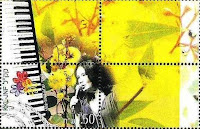
Naomi Shemer (1930-2004) - the most readily identified artist in the world of Israeli music following the establishment of the State. She wrote and composed hundreds of songs that became Israeli classics thanks to her wonderful integration of words and melodies. Her most famous song - " Jerusalem of Gold " - has become, in fact, a second "National Anthem" in Israel. Jerusalem of Gold" (Yerushalayim Shel Zahav) was written by Naomi Shemer in 1967. The original song described the Jewish people's 2000-year longing to return to Jerusalem; Shemer added a final verse after the Six-Day War to celebrate Jerusalem's unification under Israeli control. Naomi Shemer wrote the original song for the Israeli Music Festival on 15 May 1967, th e night after Israel's nineteenth Independence Day. She chose the then-unknown Shuli Nathan to sing the song. At that time, the Old City was under Jordanian rule; Jews had been barred from entering, and many holy sites had be...

"God Bless America", America's Unofficial Anthem

Image
With this 2010 stamp, the U.S. Postal Service honors Kate Smith , the celebrated singer and entertainer whose signature song, “ God Bless America ” (composed by Irving Berlin), has been called America´s unofficial national anthem. The stamp art duplicates artwork created for the cover of a CD titled “Kate Smith: The Songbird of the South.” The artwork was based on a photograph of Smith taken in the 1960s. Berlin originally wrote the song in 1918 while serving in the U.S. Army at Camp Upton in Yaphank, New York, but decided that it did not fit in a revue called Yip Yip Yaphank, so he set it aside. The lyrics at that time included the line, "Make her victorious on land and foam, God bless America..." as well as "Stand beside her and guide her, to the right with the light from above." Music critic Jody Rosen comments that a 1906 Jewish dialect novelty song, "When Mose with His Nose Leads the Band", contains a six-note fragment that is "instantly recogniz...

The National Anthem of the United Arab Emirates

Image
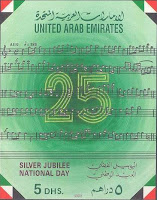
The United Arab Emirates (UAE) is a federation of seven emirates situated in the southeast of the Arabian Peninsula in Southwest Asia on the Persian Gulf, bordering Oman and Saudi Arabia. The UAE consists of seven states, termed emirates, which are Abu Dhabi, Dubai, Sharjah, Ajman, Umm al-Quwain, Ras al-Khaimah and Fujairah. The capital and second largest city of the United Arab Emirates is Abu Dhabi. It is also the country's center of political, industrial and cultural activities.    Before 1971, the UAE were known as the Trucial States or Trucial Oman, in reference to a nineteenth-century truce between Britain and several Arab Sheikhs. The name Pirate Coast was also used in reference to the area's emirates in the 18th to early 20th century. The political system of the United Arab Emirates, based on the 1971 Constitution, comprises several intricately connected governing bodies.    Islam is the official religion and Arabic is the official language. The United Ar...

Union of Soviet Socialist Republic's "The Internationale"

Image
When the Soviet Union was created in 1922 from a merger between Russia and other neighbouring soviet communist republics, the new national anthem that was in use was the " Internationale ", a socialist anthem written in the late nineteenth century by two Frenchmen, Arkady Yakovlevich Kots (lyrics) and Pierre Degeyter (music) This song was already in use as Russia's de facto anthem due to it being the party song of the Bolsheviks who seized power in the 1917 October revolution and, with Russia being the leading republic in the union, it was their anthem that would be used. "The Internationale" was never formally adopted by the Soviet Union as a national anthem (though it was formally adopted as the party anthem of the Communist Party of the Soviet Union), yet was used on a de facto basis.   "The Internationale" has since been used by a variety of communist, socialist, and other left-wing groups as their anthem, making it the unofficial anthem of soc...

Francisco da Silva- Brazilian Anthem Composer

Image
Brazil's anthem was originally composed in 1822 (the year of independence) and first performed in 1831. During the imperial period (1822-1889) and for the first few years of the republican period thereafter, the anthem was performed without words. After becoming a republic in 1889, it was often suggested among the republican groups in the country that a new anthem should be adopted, as the current anthem was composed during the imperial era, yet the anthem that had been in use ws declared official on January 20, 1890. The anthem was still without official words, and each state started adopting their own words to the anthem. In 1906, it was brought forward that lyrics for the anthem should be written, and in 1909 a poem by Joaquim Osório Duque Estrada was composed. However it wasn't until 1922, for the 100th anniversary of independence, that Osório Duque Estrada's poem was adopted, with several changes to the text. Brazil, like many other "federalist" nati...

Alexei Lvov and The Hymn of Imperial Russia

Image
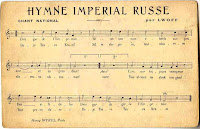
Prince Alexei Fyodorovich Lvov (June 5, 1799 in Tallinn–December 28, 1870 in Romainiai (now Kaunas) was a Russian composer. He composed the Imperial Russian national anthem Bozhe, tsarya khrani (also known as God Save the Tsar). He wrote the opera Undine in 1846. He was entombed in the Pažaislis Monastery, Kaunas (Lithuania).   Lvov was born into a family which was keenly interested in music. He was the son of Feodor Petrovich Lvov, who was Maestro of the Imperial Chapel in St Petersburg from 1826 to 1836 (having succeeded Bortnianskij).   Alexei Fyodorovich began violin lessons at a very young age and performed regularly in concerts given at his home: for instance, at 9 he was the soloist in a performance of a violin concerto by Viotti. Although he had a number of teachers in his youth, from the age of 19 onwards he began to study independently, seeking to develop his own personal style through careful attention to the works of such celebrated violinists as Corelli, Tarti...

National Anthem on Stamp Issued by Another Country

Image
Check out these three anthem stamps- something's not right in the picture. Stamps from Nicaragua containing the score of France's La Marseillaise ? Italian stamps with the score of Poland's national anthem and a stamp from Mexico featuring the national anthem of the Dominican Republic ? Stamps of national anthems are usually issued by the country who owns the anthem, but not in this case. These are real anthem stamps containing the score of the national anthem. To my knowledge, Nicaragua has not even issued a stamp of its national anthem. Italy has issued a stamp of its anthem lyricist, Goffredo Mameli , but not an anthem score. The Dominican Republic is one of the few countries that has issued several anthem stamps (at least 3, I think). I really don't know the reason why these countries featured the national anthem of other countries. Please email me if you know why or if your have other anthem stamps not featured here.

The National Anthem of Togo

Image
In 1979, the national anthem of Togo was replaced with one written collectively by members of the ruling party Rassemblement du Peuple Togolais. (The anthem might also have been the anthem of the party as well.) The anthem was changed back to the original one in the early 1990s, around the same time that democratic reforms were put in place under Western pressure and a new constitution permitted opposition parties. The anthem was in use until 1979.   Originally adopted on independence in 1960, the " Salut à toi, pays de nos aïeux " (Hail to thee, land of our forefathers), the present national anthem was replaced in 1979 and readopted in 1992, when Western-mandated reforms were brought in and one-party rule dropped. The music and lyrics were written and composed by Alex Casimir-Dosseh .   Alex Casimir Dosseh is a prominent musician from Togo. He was born on August 16, 1923 in Vogan. He had his music education in Europe and his composition, "Hail to thee, Land of our...

Palma, De Leon and Osias- Philippine Anthem Lyricists

Image
The Philippine National Anthem lyrics has three versions- "Filipinas", the Spanish (original) version, written by Jose Palma , "Lupang Hinirang" the Tagalog version, written by Felipe Padilla de Leon and "Philippine Hymn", the English version, written by Camilo Osias . Presently, only the Tagalog or Filipino version is used. José Palma (3 June 1876 - 12 February 1903) was a Philippine poet and soldier. He was on the staff of La Independencia at the time he wrote his "Filipinas," a patriotic poem in Spanish. It was published for the first time in the issue of the first anniversary of La Independencia on 3 September 1899. The poem fit the tune of the music of the Marcha Nacional Filipina, and since then became the national anthem of the country. Palma was born in Tondo, Manila, on 3 June 1876, the youngest child of Don Hermogenes Palma, a clerk at the Intendencia Office, and Hilaria Velasquez. His older brother was Rafael Palma. After finishin...

The National Anthem of Yugoslavia

Image
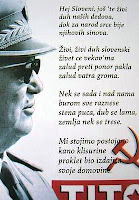
" Hej Slaveni " was composed in the mid nineteenth century by a Slovak in response to the loss of cultural identity in his homeland. Taking inspiration from the Polish anthem (which the melody is almost identical to), he composed an anthem that soon became popular with the whole Slavic community, in fact becoming the anthem of Slovakia during World War II (with Slovak words).    Being a confederation of mainly Slavonic states , the song seemed to be a natural fit for post-royalist Yugoslavia. It was sung at the first meetings of the resistance movement (later, the government), and became the temporary national anthem upon the re-establishment of Yugoslavia after the Axis defeat. A search was undertaken for a permanent anthem, but "Hej Slaveni" remained the most popular choice with the citizens; it was declared the temporary anthem in 1977, and was finally made official in 1988.   After most of the members of the Yugoslav federation had declared independence in the...