Posts

Showing posts with the label Lyricist

Dominican Republic 2016 National Anthem 50th Anniversary

Image
On 7 June 1897, the Congress of the Dominican Republin passed an act adopting "Himno Nacional" with the original music and revised lyrics as the country's official national anthem; however, then President Ulises Heureaux (1846-1899) vetoed the act because the lyric's author, Prud’Homme, was an opponent of the president and his administration. In 1899, Heureaux was assassinated, and the political disorder that ensued prevented the national anthem's legal adoption until 30 May 1934 when "Himno Nacional" was officially adopted and signed into law. The Spanish name of the Dominican Republic, "República Dominicana", is never used in the anthem's official Spanish lyrics nor is the denonym for Dominicans, "dominicanos". Rather, the indigenous word for the island Hispaniola, "Quisqueya", is used twice and its derivative denonym, "quisqueyanos", is used once. However, research later shows that these ...

Guatemalan Anthem Lyricist on Stamps

Image
Written in response to a contest calling for a national anthem to be adopted, the first ever playing of the winning entry took place during a lyric-literary meeting taking place at the Colon Theater, the night of Sunday 14 March 1897, as one of the main events of the Central American Exposition, and the author of the music was decorated with a gold medal and honor diploma. (Ovalle had been known previously for setting to music "Himno Popular" (The People's Anthem) by the poet Ramón P. Molina. It is unclear whether the music used for Ovalle's work was the same as the music that was submitted for the national anthem competition.) The author of the lyrics, however, was submitted anonymously, it was not until 1911, when it was discovered that the author was the Cuban poet Jose Joaquin Palma, who on his deathbed was honored with a silver wreath placed on his head, while outside the public and the bands sang the Himno Nacional. The original lyrics were modified slight...

Isle of Man Anthem on Europa Stamps

Image
This is a Europa stamp featuring the lyrics of the anthem of the Isle of Man on the tab.  This set is compose of two stamps values of  25p and 30p.  Previously the anthem of the Isle of Man was already feature here .  The anthem composer and lyricist were shown in the stamp.  A Europa stamps are special stamps issued by European postal administrations under the aegis of PostEurop and which have Europe as their central theme. Europa stamps should underline cooperation in the domain of posts, particularly as regards the promotion of philately and contribute to making the public aware of common roots, culture and history of Europe and common goals." In 2002, more than 50 European countries and territories issued Europa Stamps. The first issue dates from 1956 with 6 countries participating. From 1993 all the stamps have "Europa" inserted into the design in small print. For the new millennium in 2000, the common design once more replaced the common theme. T...

Sierra Leone National Anthem on Stamps

Image
Formerly a British colony, this west African nation adopted its national anthem, "High We Exalt Thee, Realm Of The Free", upon independence in 1961. The composer of the music, John Joseph Akar , was the first post independence Director of the Sierra Leone Broadcasting Service (SLBS) as well as the founder of the Sierra Leone national Dance Troupe, and the lyricist Clifford Nelson Fyle , was a professor at Fourah Bay College in Sierra Leone. John Joseph Akar (1927–1975) was a Sierra Leone-an of Lebanese descent entertainer, writer, and diplomat. He served as Sierra Leone-an Ambassador to the United States. Today, he is probably best known for composing the music of the Sierra Leone's National Anthem. Akar was born in the small town of Rotifunk, Moyamba District in the Southern P rovince of Sierra Leone, to an ethnic Sherbro mother and to a Lebanese father. Akar attended the E.U.B. primary school in Rotifunk, and proceeded to Albert Academy secondary school in Freetown. ...

Dr. Sun Yat Sen, Taiwan Anthem Writer

Image
Sun Yat-sen (12 November 1866 – 12 March 1925) was a Chinese revolutionary and president. As the foremost pioneer of Nationalist China, Sun is referred to as the "Father of the Nation" in the Republic of China (ROC), and the "forerunner of democratic revolution" in the People's Republic of China. Sun played an instrumental role in the overthrow of the Qing dynasty during the Xinhai Revolution. Sun was the first provisional president when the Republic of China was founded in 1912 and later co-founded the Kuomintang (KMT), serving as its first leader. Sun was a uniting figure in post-Imperial China, and remains unique among 20th century Chinese politicians for being widely revered amongst the people from both sides of the Taiwan Strait. Although Sun is considered one of the greatest leaders of modern China, his political lif e was one of constant struggle and frequent exile. After the success of the revolution, he quickly fell out of power in the newly founded Re...

Galician Anthem Composer and Lyricist on a Special FDC Cancel

Image
Pascual Veiga Iglesias ( April 9 of 1842 - Madrid , July 12 of 1906 ) was a musician, musical director, organist and composer of the National Anthem of Galicia . Veiga started his musical studies as a child in the choir of the Cathedral Mindoniense. At thirteen he began to teach music theory and harmony in the chapel of the cathedral. In 1964 he moved to La Coruña and served as organist of the Church of Our Lady of the Field. I n 1865 he was appointed vice president of Section Music Society Youth Fraternity. His dedication to music led him to win a prize in 1877 with the Glee Club Bragantino. He left year later, and founded the Glee Club Corunna. In 1880 he was invited by the Society of Floral Games of Pontevedra , and premiered his most emblematic work, the Alborada Gallega. Two years later he founded El Nuevo Orfeon, which soon became known as el Orfeon Echo, and that continues today. In 1889 he founded the Choral Society called Corunna Number 4, a group that won the gold medal a...

Naphtali Herz Imber, Israeli Anthem Lyricist

Image
Naphtali Herz Imber was a Jewish poet and Zionist who wrote the lyrics of Hatikvah , the national anthem of the State of Israel. Naphtali was born in Złoczów (now Zolochiv, Ukraine), a town in Galicia, Austrian Empire. He began writing poetry at the age of 10 and several years later received an award from Emperor Franz Joseph for a poem on the centenary of Bukovina's joining to the Austrian Empire. In his youth he traveled in Hungary, Serbia, and Romania. In 1882 Imber moved to Palestine as a secretary of Sir Laurence Oliphant. In 1886 in Jerusalem he published his first book of poems entitled Morning Star. One of the book's poems was Tikvateinu ("Our Hope"); its very first version was written yet in 1877 in Iaşi, Romania. This poem soon became the lyrics of the Zionist anthem and later the Israeli national anthem Hatikvah. In 1887 he returned to Europe and lived in London; then traveled again, visited India and finally moved to the Unites States in 1892. Imb...

The Sixth Floor Museum, JFK and Assassinated Composers and Lyricist

Image
Today marks the 47th anniverary of the assassination of John F. Kennedy , the 35th President of the United States, which took place on Friday, November 22 , 1963, in Dallas, Texas, at 12:30 p.m. in Dealey Plaza.    Kennedy was fatally shot while riding with his wife Jacqueline in a Presidential motorcade. God bless his soul🙏... I was fortunate to have visited the The Sixth Floor Museum at Dealey Plaza in Dallas Texas which is located on the si xth and seventh floors of an early 20th-century warehouse known in 1963 as the Texas School Book Depository.    Opened on Presidents Day 1989, the Museum has since welcomed more than 6 million visitors from around the world—people of all ages seeking information and understanding about the assassination of President John F. Kennedy.    The museum tours are self-guided. After the tour, JFK memorabilia is sold at the museum store near the entrance. I was able to get a sticker magnet which showed JFK on a postage ...

Jenneval- Belgian Anthem Lyricist

Image
Louis Alexandre Dechet (Lyon, 20 January 1801 - Lier, 18 October 1830) was a French actor and is known as author of the text of the Brabançonne , the Belgian national anthem. His pseudonym was Jenneval , possibly named after the drama Jenneval, ou le Barnevelt français (1769) of Louis Sébastien Mercier. Dechet worked in Ajaccio, Marseille and in 1826 at the Paris Odéon. Via Rijsel he finally came to Brussels, where he played at La Monnaie. In 1828 he returned to Paris in order to work at the Comédie Française, but returned to Brussels immediately after the July Revolution in 1830. He there served with the city guard which was responsible for maintaining law and order. Dechet is said to have written the text of the Brabançonne during the first revolutionary gatherings at the café "L'Aigle d'Or" in the Brussels Greepstraat in August of 1830, shortly after the performance of the opera La Muette de Portici, which triggered the Belgian revolution. During the Belgian Revol...

Palma, De Leon and Osias- Philippine Anthem Lyricists

Image
The Philippine National Anthem lyrics has three versions- "Filipinas", the Spanish (original) version, written by Jose Palma , "Lupang Hinirang" the Tagalog version, written by Felipe Padilla de Leon and "Philippine Hymn", the English version, written by Camilo Osias . Presently, only the Tagalog or Filipino version is used. José Palma (3 June 1876 - 12 February 1903) was a Philippine poet and soldier. He was on the staff of La Independencia at the time he wrote his "Filipinas," a patriotic poem in Spanish. It was published for the first time in the issue of the first anniversary of La Independencia on 3 September 1899. The poem fit the tune of the music of the Marcha Nacional Filipina, and since then became the national anthem of the country. Palma was born in Tondo, Manila, on 3 June 1876, the youngest child of Don Hermogenes Palma, a clerk at the Intendencia Office, and Hilaria Velasquez. His older brother was Rafael Palma. After finishin...

The Royal Anthem of Denmark

Image
Denmark is one of a handful of nations which have a separate "royal" anthem from the people's "national" anthem. The royal anthem is one of the oldest in the world; adopted in 1780. Special events for the royal house are marked with the royal anthem.   The lyrics first appear in Johannes Ewald 's historical drama "The Fishermen" and specifically names heroes in the wars against Sweden in the 17th and 18th centuries. The composer of the anthem is unknown.   Denmark is also unique in that it and New Zealand are the only two nations in the world with two official national anthems. Officially, " Kong Christian " is both the national and royal anthem and has equal status with " Der er et yndigt land ", the national anthem.   Johannes Ewald (18 November 1743 – 17 March 1781) was a Danish national dramatist and poet. Ewald, normally regarded as the most important Danish poet of the 2nd half of the 18th Century, led a short and t...

"Le Chant des Girondins"

Image
The words for the verses of " Le Chant des Girondins " (The Song of Girondists), used during the Second Republic, came from the drama "Le Chevalier de Maison-Rouge" by the famous writer Alexandre Dumas with Auguste Maquet . The lines of the refrain were borrowed from "Roland à Roncevaux", a song written in Strasbourg by Claude-Joseph Rouget de Lisle , the author of "La Marseillaise". The anthem was in use from 1848-1852. Alphonse Varney (1 December 1811 – 7 February 1879) was a French conductor, mainly of opera. His son was the composer Louis Varney who studied music with his father. He studied at the Paris Conservatoire including counterpoint with Reicha. Varney conducted the Théâtre de Ghent in 1835, followed by the Théâtre Historique, the Théâtre Lyrique (which he left in 1852 to spend more time composing, and conducting in Ghent), the Théâtre des Bouffes Parisiens from 1857 (from 1862-64 he was also director and staged works by Offenbach)...

The National Anthem of Cyprus

Image
Cyprus is a bi-national community of Greeks and Turks, where Greeks are the majority and the ruling government. When Cyprus was declared independent from Great Britian in 1960, other national symbols such as the flag were enshrined in the new nation's constitution, but there was no mention of an anthem. Much debates ensued, and neither community could agree on a national anthem; during foreign state visits, different instrumental marches were used. In the early 1970s, it was decided that the Greek anthem would be used by Cyprus as well. (The Turkish community does not recognize this and instead uses the Turkish anthem for their self-proclaimed nation.)   In 2004, as a requirement of joining the European Union, a peace plan was proposed by UN Secretary General Kofi Annan, which included different national symbols, to make them more inclusive of both communities. This also included a wordless anthem that was agreed to by both Turkish and Greek members of the national symbols commi...

The The National Anthem of Brittany

Image
Brittany , a region of France, has a culture and language all its own (the language is more Celtic than French). Like other Celtic regions of the area, such as Cornwall, the anthem melody used is taken from the Welsh anthem, composed by James James (with some minor note changes). The lyrics were written by François Taldir-Jaffrennou in 1897 and the adaptation of the Welsh anthem was first published the following year, with the appropriate title "Henvelidigez" ("Adaptation"). It was adopted as the Breton national anthem (and a song of Welsh-Breton friendship) in 1903 at a meeting of the Union Régionaliste Bretonne, a Breton cultural and political organization. Francois-Joseph-Claude Jaffrennou (March 15, 1879 - March 26, 1956) was a Breton language writer and editor. He was a Breton nationalist and a neo-druid bard. He is also known as François Taldir-Jaffrennou, since he also used the Druidic name Taldir ("Wall of Steel"). He was one of the pioneers of t...

William Blake on Stamps

Image
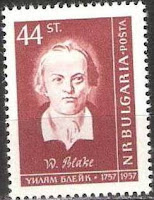
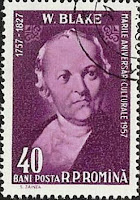
William Blake (28 November 1757–12 August 1827) was an English poet, painter, and printmaker. Largely unrecognised during his lifetime, Blake is now considered a seminal figure in the history of both the poetry and visual arts of the Romantic Age. His prophetic poetry has been said to form "what is in proportion to its merits the least read body of poetry in the English language". His visual artistry has led one contemporary art critic to proclaim him "far and away the greatest artist Britain has ever produced". Although he lived in London his entire life except for three years spent in Felpham he produced a diverse and symbolically rich corpus, which embraced the imagination as "the body of God", or "Human existence itself". Considered mad by contemporaries for his idiosyncratic views, Blake is held in high regard by later critics for his expressiveness and creativity, and for the philosophical and mystical undercurrents within his work. His p...

The National Anthem of Cambodia (Nokoreach)

Image
In the 1960s, Cambodia became more and more involved into the Vietnam war; to avoid conflicts with the USA and with communist North Vietnam, Prince Sihanouk declared Cambodia a neutral state, but he allowed North Vietnam to transport military goods through Cambodian territory to supply the communist Vietcong guerilla in South Vietnam with weapons and equipment. On 18th March 1970, General Lon Nol lead a military coup against Sihanouk and formed a pro-American government, which gave the US Army permission to fight against the Vietnamese communists on Cambodian territory. General Lon Nol proclaimed Cambodia the "Khmer Republic", and the country got a new flag and national anthem, which remained in use until the communist Khmer Rouge seized power in 1975. It is unclear whether this anthem had words or not. A portion of what could be the anthems lyrics appears, translated into English, in Chanrithy Him's book "When Broken Glass Floats", yet information from the Khm...

England's "Jerusalem"

Image
As a country within the United Kingdom, the official anthem of England is that of the United Kingdom, namely " God Save the Queen ". However, like the other constituent countries in the UK, there is often a need for a unique English anthem with a separate identity from the anthem of the UK as a whole, one that is used in some situations, and currently enjoys the most popular support, is " Jerusalem ". First appearing as a poem by William Blake entitled "And did those feet in ancient time" in the early 19th century, it is based on a tale that Jesus visited what is now England as a youth. The "dark Satanic mills" phrase is a reference to the factories and mills of the Industrial Revolution then just beginning, forever changing the landscape and society. The poem did not garner much attention until the First World War over a century later, when it was included in a patriotic anthology of poems, and was seen as expressing what England was fighting f...

"Hino da Carta Constitucional" (Hymn to the Constitutional Charter)

Image
In May 1834, the "Hymn to the Constitutional Charter" was established as the anthem of the Kingdom of Portugal , and it was the official anthem until the establishment of the Portugese Republic, replacing the monarchy, in 1910. It was written in 1822 by Crown Prince Pedro of Bragança (later Emperor Pedro I of Brazil) to celebrate the Portuguese Constitution imposed by the liberals in Portugal. It is believed that he wrote both the lyrics and music of the hymn, since he was considered a very skilled musician; he titled this work in 1822 as "Imperial and Constitution Hymn", and when he became King of Portugal in 1826 it was known as "Hymn to the Charter" and already very popular. Prince Pedro of Bragança, later Emperor Pedro I of Brazil (October 12, 1798 – September 24, 1834), was the founder and first ruler of the Empire of Brazil and also King of Portugal as Pedro IV, having reigned for 8 years and almost 2 months, respectively. His full name was Pedro d...

"Republiko Nasha, Zdravey!" (Hail to the Republic!)

Image
The Bulgarian anthem, "Republiko nasha, zdravey!" (Hail to the Republic!) in use between the abolition of the monarchy in 1944 and the establishment of a new anthem in 1950 after the communists firmly gained power, was composed by Georgi Dimitrov (the same as the co-composer of "Balgarijo Mila" , but not the same as the communist leader by that name of that period). The lyrics to the anthem was written by Bulgarian writer Krum Penev . 1. Yarema na robstvo surovo 1. . The collar of slavery hard I mraka na siva sadba A nd darkness of grey fate Niy srinakhme s ogan i slovo We crashed with fire and word V zhestoka neravna borba In cruel uneqal fight 1. Republiko nasha narodna 1. Our people’s republic, Republiko nasha zdravej Our republic- Hail! Zemiata ni dnes e svobodna Today our land is free, Svobodno dnes vseki zhivej Today everyone lives free! 2. Za nas svobodata ...

Drenova- The Albanian Anthem Lyricist

Image
Aleksandër Stavre Drenova , best known under his pen name Asdreni (11 April 1872 - 1947), was one of the most well-known Albanian poets. One of his most recognizable poems is the Albanian National Anthem, Hymni i Flamurit . Born in the village of Drenovë, near Korçë, he studied at a Greek school in his village. His father died when he was just thirteen. In 1885, Drenova moved to Bucharest, Romania, where he rejoined his brothers. While there, he was exposed to other Albanian writers and nationalists. In 1904, Asdreni published his first collection of ninety-nine poems called Rreze dielli ("Sun Rays"), dedicated to Skanderbeg, the Albanian national hero. His second ninety-nine poem collection, Ëndrra e lotë ("Dreams and Tears") was published in 1912 and was dedicated to the British anthropologist Edith Durham. Asdreni's third collection, Psallme murgu ("Psalms of a Monk"), came in 1930. After a brief return to Albania in 1914, Aleksandër returned to Rom...