Posts

"Largest Stamp Mosaic in the World"

Image
Hongkong Post set the New Guinness World Record for the 'Largest Stamp Mosaic'. The Guinness World Record has confirmed that the Stamp Mosaic, measuring 6.45m wide and 3.97m high, with over 69,000 used stamps donated by Hongkong Post staff and 98 overseas postal administrations, created by Hongkong Post on 30 August 2005 is the largest stamp mosaic in the world. This extraordinary and unprecedented result was achieved through the dedication and teamwork of all participating staff and their families . This successful attempt has gained another World Record entry for Hong Kong and the avant-garde initiative demonstrates not only the team spirit and creativity of Hongkong Post, but also the solidarity among postal administrations. In celebration of the 10th Anniversary of the Post Office Trading Fund, for the first time in Hong Kong, over 1,480 Hongkong Post staff and their families participated in affixing the sta mps and created this gigantic stamp mosaic during their spare t...
The Royal Anthem of Thailand

Image
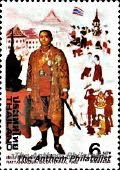
Thailand is one of a few monarchies (like Denmark and Sweden) that have a separate anthem for the royal family, as opposed to the national anthem for the citizens. The Thai royal anthem is performed during state occasions and public meetings, as well as when a high-ranking member of the royal family is present for a function. "Phleng Sansasoen Phra Barami" (A Salute to the Monarch), the royal anthem also served as the third anthem of Siam (as Thailand was then known) from 1888 until the 1932 coup. The music was com posed by a Russian musician, Pyotr Schurovsky for lyrics written by Pr ince Narisara Nuvadtivongs. The lyrics were revised by King Rama VI in 1913. Above is a stamp of Prince Vajiravudh who later became King Rama VI. He was the sixth monarch of Siam under the House of Chakri, ruling from 1910 until his death. Vajiravudh is known for his efforts to create and promote Siamese nationalism. His reign was characterized by Siam's movement further towards democracy a...

The Ruins of Kobe, Japan

Image
I've always wondered why some Japanese tourist "like" to visit some "ugly" places in our country. The are amazed at the dirt and squalor of Smokey mountains, entertained by the "moon-crater"- like quality of our roads, and admire our filthy cheap products. On a trip to a beach resort in Mactan, we had to traverse a bumpy, rocky off-road trail. A Japanese companion mused, "We never have these kind of roads in Japan. This is enjoyable! Like riding bump cars!"     In order to fully appreciate beauty, one has to experience the ugly. One canno t really fathom ugliness without a first-hand encounter with beauty. I had this experience when I visited Kobe, Japan- a mesmerizingly beautiful city. Imagine, a ruin - a sordid reminder of the earthquake that struck Kobe several years ago- turned into a Museum and a Memorial park. This is the only part of Kobe that is "dirty" because it was never rehabilitated after the quake. The dilapidated st...

The National Anthem of Costa Rica

Image
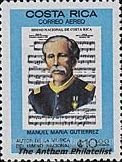
In 1852, Costa Rica did not have a national anthem. However, when the United States and the United Kingdom accredited their diplomatic representatives in Costa Rica, President Juan Rafael Mora Porras, wanted to host a welcome ceremony for the missions. A decision was made that a national anthem for Costa Rica should be composed for the occasion, and the president requested Mr. Manuel María Gutiérrez , Director of the Costa Rican National Army Orchestra, to compose the music. It was told that Mr. Gutierrez would be incarcerated for a month if he refused. Unfortunately Don Manuel Maria Gutierrez ran out of time and as a consequence was imprisoned at the Cuartel de Armas, where he looked through a small window out onto the Plaza Mayor. Feeling inspiration, he was able to finish the composition and on the 11 of June, 1852, at the Palacio Nacio nal, the national anthem of Costa Rica was heard for the first time alongside those of the United States and England. In 1903, a contest was held f...

The National Anthem of Argentina

Image
The lyrics of the Himno Nacional Argentino (the national anthem of Argentina) were written by Vicente López y Planes, and the music was composed by Blas Parera. This song was adopted as the national anthem on May 11, 1813, three years after the May Revolution (Revolución de Mayo). May 11 is therefore Anthem Day in Argentina. On May 24, 1812, Vicente López attended a play presented at the Casa de la Comedia, Buenos Aires, titled El 25 de Mayo, which retold the story of the May Revolution that happened two years earlier. The play, written by Luis Ambrosio Morante, concluded with an anthem sung by the actors. López felt inspired and that same night wrote the first verses of an anthem that would replace Morante's, for which Blas Parera had composed the music. The General Constituent Assembly, the autonomous government of the time, approved the new anthem as Marcha Patriótica (Patriotic March) on May 11, 1813, and commanded Parera to compose a new music. Some authors say that Parera ac...

The National Anthem of Mexico

Image
After independence from Spain in the early nineteenth century, there were many songs popular with the public that were an attempt to be a national anthem, but none succeeded. Finally, in 1853, President Santa Ana announced a nation-wide contest for the lyrics for a new national anthem. One of the entrants, an accomplished poet named Francicso González Bocanegra , was originally not interested in running. However, his fiancée was confident in his skills and, under false pretenses, lured him into a room of her parent's house and locked him inside, refusing to let him out until he wrote an entry for the contest. After four hours, using the pictures in the room of the epics of Mexican history as his inspiration, Bocanegra finally won his freedom by slipping a ten verse poem under the door. (Only the first, fifth, sixth, and tenth verses officially make up the anthem.) His fiancée and her father approved of the submission, and so did the judging committee, his entry won unanimously. Af...

The National Anthem of the Dominican Republic

Image
José Reyés was inspired to make this anthem after noticing a published copy of the Argentine anthem. Reyés believed that his country should also have an anthem, so he invited his friend Emilio Prud'homme to write the lines while he composed the music. Soon after Reyés managed to get his anthem published as well; it was well-received by the public and soon grew in popularity. The title of the national anthem, " Quisqueyanos valientes" (Valient Sons of Quisqueye) , refers to the original native inhabitants' word for Santo Domingo island.) A motion in the National Congress was made in 1897 by deputy Rafael Garcia Martinez to give the song official status, but the president refused to sign the bill into law, possibly because of Prud'homme's disagreement with President Heureaux's dictatorial government. It wasn't until 1934, many years after Heureaux's death, that President Rafael Leonidas Trujillo Molina officially adopted the song as the nationa...