Posts

The Panama National Anthem

Image
Panama is an isthmus (a narrow strip of land enclosed by water on two sides), and it's anthem is entitled, appropriately, "Himno Istemño". The anthem was first performed by citizens in the streets on the day of independence in 1903, and was fully adopted as an anthem in 1925. Santos Amatriaim Jorge (1870 - 1941), composed the music for the Panamanian national anthem "Himno Istmeno". He was born in Peralta, Navarre, Spain in November 1870. After studying music at the Conservatorio de Madrid, he moved to the Isthmus of Panama in 1889 where he taught music. In 1892, he became the director of the military band of the Colombia Battalion. The lyrics of the Panamanian national anthem were written by Jeronimo de la Ossa . He was born in Panama City on April 9,1847 and died there in 1907. He was a romantic poet who studied civil engineering in Chile. He later represented the Panamanian consulate in Chile and worked for the France Canal Company. ...

Senghor- Senegal Anthem Lyricist

Image
"Pincez Tous vos Koras, Frappez les Balafons" (Pluck Your Koras, Strike the Balafons)is Senegal's national anthem. The "koras" (a harp-lute) and "balafons" (drums) mentioned in the anthem title are native instruments to this African nation, and can be used in the playing of the national anthem. The composer of the music. Herbert Pepper, also composed the music for the Central African Republic anthem, and the words were by Senegal's first president, Leopold Senghor. Léopold Sédar Senghor (9 October 1906 – 20 December 2001) was a Senegalese poet, politician, and cultural theorist who served as the first president of Senegal (1960–1980). Senghor was the first African to sit as a member of the Académie française. He was also the founder of the political party called the Senegalese Democratic Bloc. He is regarded by many as one of the most important African intellectuals of the 20th century. Léopold Sédar Senghor was born on 9 October 1906 in the sma...

The National Anthem of Guinea-Bissau

Image
In 1963, a delegation from Portugese Guinea (as it was then known, as a Portugese colony) visited China. After hearing a song composed by Xiao He , one of the independentist politicians in attendance, Amilcar Lopes Cabral, said that he would like that composer to compose a similar song to inspire the people of Portugese Guinea to strive for independence. Using African music as his inspiration, Xiao He composed the music, which became the anthem of Guinea-Bissau upon 1974 independence. Since Cabral's organization included both Portugese Guinea and Cape Verde, the anthem was also adopted by Cape Verde when their independence was achieved a year later. The two nations even proposed to merge, but this merger dissolved before it was realized, and a few decades later, Cape Verde subsequently adopted its own anthem. Amílcar Lopes Cabral (12 September 1924 – 20 January 1973) was an African agronomic engineer, writer, Marxist and nationalist politician. Also known by the nom de guerre Abel...

The National Anthem of the Central African Republic

Image
The words to "La Renaissance" were written by the nation's first president, Barthélémy Boganda and the melody was composed by Herbert Pepper , the same person who wrote the melody for the Senegalese anthem. The anthem was adopted for use in 1960. Barthélemy Boganda (4 April 1910 – 29 March 1959) was the leading nationalist politician of what is now the Central African Republic. Boganda was active prior to his country's independence, during the period when the area, part of French Equatorial Africa, was administered by France under the name of Oubangui-Chari. He served as the first Prime Minister of the Central African Republic autonomous territory. Boganda was born into a family of subsistence farmers, and was adopted and educated by Roman Catholic Church missionaries. In 1938, he was ordained as the first Roman Catholic priest from Oubangui-Chari. During World War II, Boganda served in a number of missions and after was persuaded by the Bishop of Bangui to enter pol...

The National Anthem of Barbados

Image
The Barbados national anthem was adopted upon independence on November 30, 1966. The lyrics were written by Mr. Irving Burgie, a USC music scholar who also performed music under the name Lord Burgess. When Mr. C. Van Roland Edwards composed the Music for the National Anthem he was partly blind. Because of his partial blindness he was assisted in his work by his two daughters Nannette and Eullia. The music of the National Anthem of Barbados was composed by Mr. C. Van Roland Edwards who was partly blind at the time. Mr. Edwards who attended St. Peter's Church Boy's School was born in 1912 and had been writing music with no formal training. He was also a member of the British song society since 1933. Edwards wrote the Anthem for Barbados’ Independence in 1966 and was awarded $500 by the Government. He later died on April 22nd 1985. Other compositions by Van Roland Edwards include: The St. Andrew Murder, The G oodman Song,The Federation Song and Welcome to her Majesty the Que...

The National Anthem of Bangladesh

Image
Amar Shonar Bangla (My Golden Bengal) is a 1906 song written and composed by the poet Rabindranath Tagore, the first ten lines of which were adopted in 1972 as the Bangladesh national anthem. The word shonar literally means 'made of gold', but in the song shonar Bangla may be interpreted to either express the preciousness of Bengal or a reference to the colour of paddy fields before harvest. The song was written in 1906 during the period of Bangabhanga (Bôngobhôngo - 1905 Partition of Bengal) - when Bengal was divided in two halves by the British government based on religion. This song, along with a host of others, was written to rekindle the unified spirit of Bengal. It is said that the music of this song was inspired by the Baul singer Gagan Harkara's song "Kothay Pabo Tare". The first 10 lines of this song constitute the national anthem of Bangladesh. It was adopted in 1972 after the independence of Bangladesh. The English translation was done by Syed Ali Ahsa...

March on Bahama Land

Image
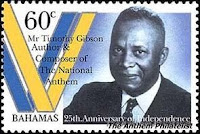
"March On, Bahamaland!" was selected as the winning entry in a national competition, and was adopted as anthem and official emblem on independence July 10, 1973. The winner of the competition was Timothy Gibson. As a former British colony and current Commonwealth realm, The Bahamas retains God Save the Queen as its "royal anthem" . Timothy Gibson composer, lyricist and educator was born in Savannah Sound, Eleuthera on April 12, 1903. He received his early education in Savannah Sound, worked as a monitor from the age of 11. At the same age he went to Arthur's Town, Cat Island, to join his brother, C. I. Gibson who was a head teacher and was given a job as monitor. He kept this post until he was 17. When his brother was transferred to Buckley's, Long Island he went with him and again worked as a monitor for one year. The following year he received a job as head teacher in Scrubb Hill, Long Island. He later came to Nassau as a student-in training at the Bo...