Posts

Glimpses of Old Cebu: Images of the Colonial Era

Image
"Glimpses of Old Cebu: Images of the Colonial Era" is a 276-page coffee table book of nearly 600 of the best photographs, postcards , stereoviews and lantern glass slides of Cebu and its many towns taken between 1870-1945. More than just a mere showcasing of rare, never-before-seen images, the book also provides a treasure trove of information accompanying nearly every picture. The author, Lucy Urgello Miller has been collecting vintage Philippine postcards and photographs for over 20 years, the thrust of her collection being Cebu . She acquired 90% of her Cebu collection in the United States where she is living with her husband Richard "Rick" Miller. Most of the collection was bought at antique postcards shows. Lucy has about 1,000 pictures and postcards on Cebu but she selected only the best and most interesting for this book. Mommy Gingging, Lucy and my wife Grace A blue-blooded Theresian, Lucy spent her entire education from kinder...

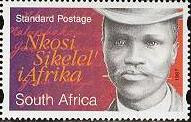
The National Anthem of the Transkei

Image
In 1976, Transkei was proclaimed by the apartheid-era South Africa as an "independent black homeland" (in actuality, an area set up to reduce the black population of South Africa by giving them citizenship in this new area.) Not internationally recognized, Transkei was re-incorporated into South Africa when the apartheid system was abolished in 1994. As a separate "nation", Transkei adopted the famous southern African song "Nkosi sikelel' iAfrika" as its official national anthem. In fact, the song was written and composed in what later became Transkei; as well, the writer of the song, Enoch Sontonga , was a member of the Xhosa people, which was the official language of Transkei. Interestingly, not only was "Nkosi sikelel' iAfrika" used for decades prior to the creation of Transkei as the anthem of the anti-apartheid movement, but also, this song became part of the anthem of the new South Africa after Transkei was re-integrated. This is a ...

The National Anthem of Zambia

Image
Upon independence in 1964, Zambia adopted the melody of "God Bless Africa" for the melody, yet different lyrics were written to specifically reflect Zambia. "God Bless Africa" is a popular song and anthem in southern Africa, the song was also formerly used by Zimbabwe, Ciskei, and Transkei, and currently by Tanzania and as part of the South African anthem. "Stand and Sing of Zambia, Proud and Free" or "Lumbanyeni Zambia" is the national anthem of Zambia. The tune is taken from the hymn Nkosi Sikelel' iAfrika (God Bless Africa), which was composed by a South African, Enoch Sontonga , in 1897, the lyrics were composed at or near Zambian independence to specifically reflect Zambia, as opposed to Sontonga's lyrics which refer to Africa as a whole. Nkosi Sikelel' iAfrika also forms the first verse of South Africa's national anthem.

The National Anthem of Tanzania

Image
Tanzania was the first African nation to use the popular African song "Mungu ibariki Afrika" (God Bless Africa) as its anthem, in 1961 when it was Tanganyika, and was retained after union with Zanzibar in 1964. It is now also used by South Africa (as part of the current anthem) and Zambia (with different words), and formerly used by Zimbabwe, Ciskei, and Transkei. The song was written collectively and composed by Enoch Mankayi Sontonga. Enoch Mankayi Sontonga (ca. 1873 - 18 April 1905) was the composer of Nkosi Sikelel' iAfrika (God Bless Africa), which has been part of the South African national anthem since 1994. It was also the official African National Congress (ANC) anthem since 1925 and is still the national anthem of Tanzania and Zambia. It was also sung in Zimbabwe and Namibia for many years. Sontonga, a Xhosa, was born in the city of Uitenhage in the Eastern Cape. He trained as a teacher at the Lovedale Institution and subsequently attended the Methodist Mission...

The National Anthem of Bonaire

Image
The Island Territory of Bonaire is one of five island territories (Eilandgebieden) of the Netherlands Antilles, consisting of the main island of Bonaire and, nestled in its western crescent, the uninhabited islet of Klein Bonaire. Together with Aruba and Curaçao it forms a group referred to as the ABC islands of the Leeward Antilles, the southern island chain of the Lesser Antilles. As part of the Netherlands Antilles, Bonaire is also a part of the Kingdom of the Netherlands. The structure of the relationship between Bonaire, the Netherlands Antilles and the Kingdom is planned for change under proposed legislation. The Netherlands Antilles is scheduled to be dissolved as a unified political entity on 10 October 2010, so that the five constituent islands would attain new constitutional statuses: Bonaire, Saba and Sint Eustatius will become special municipalities of the Netherlands, while the islands of Curaçao and Sint Maarten will become independent states within the Kingdom of the Ne...

Jose Yulo on Stamps

Image
Jose Yulo (1894 – 1976) Jurist, statesman, lawyer, Jose Yulo was one of the distinguished and outstanding leaders of the country. He was born on September 24, 1894 in Bago Negros Occidental, the fifth child of Sofronio Yulo and Segunda Yulo. His mother died when he was six years old and his father followed when he was 12. Yulo finished the first three years of his high school at the Rizal Institute in Bacolod but in 1910, he transferred to the Manila High School, where he obtained his high school diploma the following year. Among his contemporaries at the Manila High School were Jose P. Laurel and Elpidio Quirino.   Yulo wanted to take up engineering but since the course was not offered in the evening, he enrolled in the college of law of the University of the Philippine. He was then below 18, the prescribed age for admission to the university but was admitted, however, upon the special recommendation of the high school principal. UP Law dean, George A. Malcolm, employed Yulo i...

Casimiro del Rosario on Stamps

Image
Casimiro Villacin del Rosario ( 13 Jun, 1896- 15 Sep, 1982) is a foremost Filipino physicist, astronomer and meteorologist.   Dr. del Rosario is known for his researches on ultraviolet light of different wavelengths, effect of radioactive radiation on Euglena , high voltage electrical discharges in a vacuum, and many others. His works have been published in international journals such as the American Physics Review and the Journal of Franklin Institute .   He is the co-founder of the Bartol Research Foundation in Philadelphia, an institution which did pioneering researches in physics.   Dr. del Rosario was the recipient of a Presidential Award in 1965 for his contributions to physics. He was made Director of the Philippine Weather Bureau for 11 years, and the first vice-chairman of the National Science Development Board in 1958. He was conferred as a National Scientist in 1984.   Dr. Casimiro del Rosario was born on June 13, 1896 in Bantayan , Cebu to Pantale...