Posts

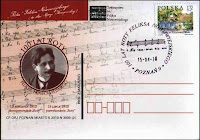
China Anthem Composer, Ni Er, on Postcard
Image
Nie Er (February 14, 1912 — July 17, 1935), was a Chinese composer. He is known for composing the national anthem of the People's Republic of China, the March of the Volunteers . In numerous Shanghai magazines he went by the English name "George Njal". Nie Er's ancestors were from Yuxi, Yunnan, in southwest China. He was born in Kunming, Yunnan. From an early age Nie Er displayed an interest in music.    From 1918 he studied at the Kunming Normal School's Associated Primary School. In his spare time, he learnt to play traditional instruments such as the dizi, erhu, sanxian, and yueqin, and became the conductor of the school's Children's Orchestra. In 1922 he entered the Private Qiushi Primary School (Senior Section), and in 1925 entered Yunnan Provincial Number One Combined Middle School. In 1927 Nie Er graduated from Yunnan Provincial Number One Combined Middle School, and entered Yunnan Provincial Number One Normal School. At school, he participated i...

Galician Anthem Composer and Lyricist on a Special FDC Cancel

Image
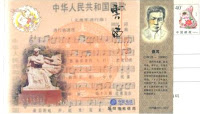
Pascual Veiga Iglesias ( April 9 of 1842 - Madrid , July 12 of 1906 ) was a musician, musical director, organist and composer of the National Anthem of Galicia . Veiga started his musical studies as a child in the choir of the Cathedral Mindoniense. At thirteen he began to teach music theory and harmony in the chapel of the cathedral. In 1964 he moved to La Coruña and served as organist of the Church of Our Lady of the Field. I n 1865 he was appointed vice president of Section Music Society Youth Fraternity. His dedication to music led him to win a prize in 1877 with the Glee Club Bragantino. He left year later, and founded the Glee Club Corunna. In 1880 he was invited by the Society of Floral Games of Pontevedra , and premiered his most emblematic work, the Alborada Gallega. Two years later he founded El Nuevo Orfeon, which soon became known as el Orfeon Echo, and that continues today. In 1889 he founded the Choral Society called Corunna Number 4, a group that won the gold medal a...

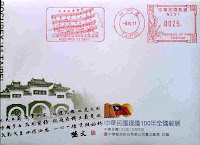
The Anthem of Taiwan on Metered FDC

Image
This is the First Day Cover of 2011 ROCUPEX Taipei Stamps Exhibition Meter Stamp from Formosa (Taiwan), Republic of China. The 2011 ROCUPEX Taipei Stamps Exhibition commemorates the 100th anniversary of the Republic (Oct 07-12,2011).    This FDC, issued on October 7, 2011 features the image of National Anthem of the Republic of China . This cover is a design error with 2 wrong Chinese characters in the National Anthem of the meter stamp. The special meter shows the score of the National anthem.   The anthem lyrics in traditional Chinese script is seen on the cachet. This FDC has a face value of 25 new Taiwan dollar.

Liberian Anthem Lyrics on an Unissued Souvenir Sheet

Image
Liberia, officially the Republic of Liberia, is a country on the west coast of Africa, bordered by Sierra Leone, Guinea, and Côte d'Ivoire. Liberia, which means "Land of the Free", was founded as an independent nation by free-born and formerly enslaved African Americans. Recently it has witnessed two civil wars, the Liberian Civil War (1989–1996), and the Second Liberian Civil War (1999–2003), that have displaced hundreds of thousands and destroyed its economy. The national anthem of Liberia, "All Hail, Liberia Hail" was composed by Olmstead Luca in 1869. The words to the anthem of this second oldest independent African nation were written by the nation's third president, Daniel Bashiel Warner, and adopted upon independence in 1847. Presumably, the anthem first had a different melody, as the current music was written in 1860. Above is an unissued souvenir sheet featuring the Liberian anthem lyrics.

Rota- Anthem of the Polish National-Territorial Region

Image
The Polish National-Territorial Region (Polish: Polski Kraj Narodowo-Terytorialny) was an autonomous region in Lithuania, self-proclaimed by the local Poles on 6 September 1990. The region included areas surrounding Vilnius, capital of Lithuania, where Poles formed the majority (60–90%). This Eastern part of Lithuania had been part of Poland (from 1922) before being attached to Lithuania under the Mutual Assistance Treaty with the Soviet Union in 1939. The autonomy region with capital in Naujoji Vilnia included 4,930 km² and population of 215,000 (66% of them Poles). The Polish autonomous movement was related to the Yedinstvo movement and had tacit support from Moscow (thus, when following the Act of the Re-Establishment of the State of Lithuania the Soviets applied a blockade against Lithuania, the areas of Eastern Lithuania with significant minority population were mostly spared of the blockade, with the aim of gaining minorities' support for Moscow). In the region, the Polish Re...

The New National Anthem of Libya

Image
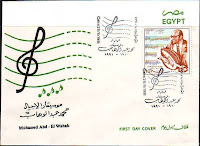
Libya, Libya, Libya (also known as Ya Beladi, "Oh my country!"), composed by Mohammed Abdel Wahab , is the new national anthem of Libya. He also composed the music for the anthems of Tunisia and the United Arab Emirates. The anthem was used until the monarchy was abolished in a coup by Moammar Qadaffi in 1969, when it was replaced with a new anthem. It was originally the national anthem from independence in 1951 until 1969 when King Idris I was overthrown by a Coup d'état led by Muammar al-Gaddafi. Gaddafi adopted the Egyptian marching song Allahu Akbar (God is Greatest) as the national anthem of the newly proclaimed Libyan Arab Republic. The anthem was a Muslim call to prayer and a statement of faith composed by Abdalla Shams El-Din and lyrics written by Mahmoud El-Sherif. During the 2011 Libyan civil war, Libya, Libya, Libya was declared the new national anthem and restored by the transitional government. Above is a first day cover of the Libyan anthem composer Moham...

The Rising Sun of Argentina as Described in the First Version of its Anthem

Image
It is still unknown who designed the coat of arms, but it is often mentioned that there were three men: Alvear, Monteagudo and Vieytes, but it is known that a few years before, President Bernardino Rivadavia asked the Peruvian Antonio Isidoro Castro to create an Argentine coat of arms, but the two schemes were never found.    The coat of arms is a figure, in which we find the following symbols: At the top is the famous sun symbol of Argentina, the gold-yellowed Sun of May, also found on the Flag of Argentina. The rising sun symbolizes the rising of Argentina, as described in the first version of the Argentine National Anthem : it says "Se levanta a la faz de la tierra una nueva y gloriosa nación," meaning "A new and glorious nation rises to the surface of earth." It must be noticed how the verb "rise" (and so in Spanish) can be used to describe the motion of the Sun.