Posts

Dominican Republic 2016 National Anthem 50th Anniversary

Image
On 7 June 1897, the Congress of the Dominican Republin passed an act adopting "Himno Nacional" with the original music and revised lyrics as the country's official national anthem; however, then President Ulises Heureaux (1846-1899) vetoed the act because the lyric's author, Prud’Homme, was an opponent of the president and his administration. In 1899, Heureaux was assassinated, and the political disorder that ensued prevented the national anthem's legal adoption until 30 May 1934 when "Himno Nacional" was officially adopted and signed into law. The Spanish name of the Dominican Republic, "República Dominicana", is never used in the anthem's official Spanish lyrics nor is the denonym for Dominicans, "dominicanos". Rather, the indigenous word for the island Hispaniola, "Quisqueya", is used twice and its derivative denonym, "quisqueyanos", is used once. However, research later shows that these ...

Yangdong Folk Village-UNESCO World Heritage Site #117

Image
After a breezing 30 minute ride from the Geongju city center, we arrived at the Yangdong Folk Village (Yangdong Village of Gyeongju), a traditional village from the Joseon Dynasty.  It is located in Gangdong-myeon, sixteen kilometers northeast of Gyeongju, South Korea, along the Hyeongsan River. Mt. Seolchang stands to the north of the village.  The village is designated as Important Folklore Materials No. 189 by the South Korean government. The size, degree of preservation, numerous cultural assets, traditionalism, beautiful natural setting all contribute to the importance of Yangdong Village. It is also a fine example of the  yangban (Korean aristocracy) lifestyle and Neo-Confucian traditions. The village is listed by the South Korean government with UNESCO as world heritage site with Hahoe folk village in 2010.

Beautiful Geongju- Cheomseongdae Observatory

Image
This observatory was built during the reign of the Silla Queen Seondeok (632-647 AD).  This is the oldest astronomical observatory in East Asia which consists of 26 steps of 30cm high stones placed above double stylobates.  Its exact dimensions are 5.17 meters in diameter and 9 meters in height and is made of granite stones with a stone base measuring 5.35 meters.   At the top, the square stones are arranged in the shape of the Chinese letter for "well".  Every part of the building from its structure and composition of each stone contains symbolical meaning.   It is filled with various scientific yet mysterious points, such as the fact that the stones that make up the letter for well at the top of the observatory are exactly the length of the stylobate.

Beautiful Geongju- Wolji Pond

Image
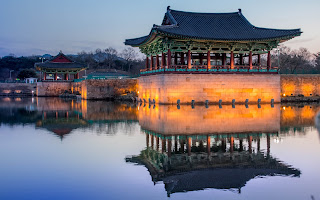
In the year 679 AD, during the 19th year of King Munmu's rule, Donggung Palace was built  as a venue for state festivals, banquets and as a prince's palace. According to to History of the Three Kingdoms (Samguksi), that inside the Palace, a pond was dug, artificial hills were created, flowers were planted, and strange animals were brought in and raised.  The pond also served as a place to entertain valuable guests and hold banquets for the king and his subjects.  The artificial pond with an area of around 190 meters in all four directions was also called the Anapji during at the Joseon dynasty. Wolji Pond was uncovered during the excavation and dredging work conducted in 1975.  The date inscribed on the roof and tiles decorated with stylized floral medallion (posanghwa),  confirmed that the original dates of construction were accurate.  During the Joseon Dynasty, the pond was neglected and became a straying place for wild ducks and geese hence bec...

The Cape Floral Region

Image
The Cape Floral Region, one of South Africa's eight World Heritage sites, comprises eight protected areas stretching from the Cape Peninsula to the Eastern Cape, cutting across spectacular mountain and ocean scenery and containing some of the richest plant biodiversity in the world.  The region was the sixth South African site to be inscribed on the World Heritage List of UNESCO. Unesco's World Heritage Committee declared the 553 000-hectare Cape Floral Region to be of "outstanding universal significance to humanity", describing it as "one of the richest areas for plants in the world".    The Cape Floral Region "represents less than 0.5% of the area of Africa, but is home to nearly 20% of the continent's flora," Unesco said. "Its plant species diversity, density and endemism are among the highest worldwide, and it has been identified as one of the world's 18 biodiversity hot-spots. "The site displays outsta...

Zimbabwe, the Beautiful

Image
After an hours flight from Johannesburg, we landed in Victoria, Zimbabwe.  The falls was originally name Mosi-oa Tunya but was renamed to Victoria in honor of the British Queen when Scottish Dr. David Livingstone discovered the place.  He was much revered here that even when Zimbabwe regained Independence  almost all traces of British influence were deleted save this place name. We were lucky to see the double rainbow and enjoy the sporadic spray of heavy mist with the sun shining ever so brightly.  This was moderate rain season so the falls were said to be in their not-so-strong flow. Had we visited during the heavy months, it would have been difficult to appreciate the vista this magnificent place offers. The Zambesi river cruise the day before the falls was exciting.  It was the first time we saw real river creatures unlike the river safaris we experienced before.  A family of pearly white tusked elephants with their babies on the Zambian side...

Independence Hall

Image
The Declaration of Independence was adopted and the Constitution of the United States of America framed in this fine early 18th-century building in Philadelphia. These events, which took place respectively in 1776 and 1787, were conceived in a national context, but the universal principles of freedom and democracy set forth in these two documents have had a profound impact on lawmakers and political thinkers around the world. They became the models for similar charters of other nations, and may be considered to have heralded the modern era of government.  Independence Hall was designed by attorney Andrew Hamilton in collaboration with master builder Edmund Woolley to house the Assembly of the Commonwealth (colony) of Pennsylvania. Begun in 1732 and finished in 1753, it is a dignified brick structure with a wooden steeple that once held the Liberty Bell.  The building has undergone many restorations, notably by architect John Haviland in the 1830s and under...