Posts

Showing posts from 2018

Mariano "Mar" Vidal: Land and Seascape Pastels

Image
The mastery of Cebuano visual artist Mariano "Mar" Vidal is grounded in a career defined by meticulous realism, structural precision, and a deep-seated discipline. While Vidal is highly celebrated as a master portraitist and a former Fine Arts professor at the University of the Philippines Cebu , h is earlier land and seascape pastel works and studies serve as the ultimate testament to his rare, foundational genius. Before scaling his work to larger-than-life canvases and complex oil compositions, his early explorations with pastel chalk laid bare his technical virtuosity and uncanny command over light and form. Pastel is an notoriously unforgiving medium. Unlike oils, which allow an artist to blend and mask mistakes seamlessly over time, dry pastels require an immediate, highly deliberate touch. Pigments sit unblended or explicitly layered stroke-against-stroke, meaning every mark tells the truth about the draftsman's hand. In his early studies, Vidal conquered this ch...

Echoes of the Earth: The Neo-Tribalism Art Movement of Cebu

Image
In the landscape of Philippine contemporary art, regional narratives have increasingly challenged the Manila-centric hegemony, offering profound explorations of identity, heritage, and community. Among these regional disruptions, the Neo-Tribalism Movement of Cebu stands out as a fascinating paradigm. Founded by the late visionary artist and Jose Joya awardee Leopoldo Aguilar Jr. , the movement emerged as a conscious rebellion against a cultural landscape that many local creators felt had become entirely too Westernized. By fusing raw, primordial expressions with modern and Western techniques, Cebuano Neo-Tribalism has re-imagined the boundaries of the canvas, evolving from an aesthetic rebellion into a profound grassroots advocacy.  Origins and Philosophy: The Primal Rebellion The Neo-Tribalism Movement took root in Cebu as an investigation into what "tribal" or "ethnic" art means in a contemporary context. For Aguilar—a graduate of the University of the Philippin...

The Angono Petroglyphs- Philippines Oldest Work of Art

Image
This is where one can see the oldest work of art in the Philippines done 3000 years ago using stone tools.  I visited this site on May 1, 2018 and what normally is a 2 to 3 hour ride from Manila to Angono-Binangonan in Rizal Province took me less than an hour, being a Labor Day holiday.  The Waze app I used was very accurate and I suggest using this because only 5% of the locals have knowledge of this place.  Ninety five percent of the visitors are out-of-townees.  The site is on an elevated area, hilly, and located inside a subdivision which is privately owned.  There are no public transportation inside so one has to walk a few minutes from the entrance to the site.  If you have a private car, there is a parking area beside the tunnel entrance to the petroglyph.  Its a 5-10 minute walk from the man-made tunnel entrance which was a little dark but cool.  There is a mini museum which use to house the artifacts like flake stone tools ...

Old Bridge Area of the Old City of Mostar

Image
                              Our passports were checked as we left Dubrovnik and entered Bosnia-Herzogovina .  Asians these days are a welcomed travelers and passing through the checkpoints was a breeze.  It was a rainy day but our hearts were not dampened by the weather and we ventured into the Old city with our young guide who started the tour in the old Town.  We saw some remnants of the ravages of war like large holes through buildings and destroyed mosques but the town was completely rebuilt out of the original materials.  Even the cobblestone streets were patterned from its prewar appearance. An interesting place we visited was a mosque where traditionally one is allowed to wear shoes inside.  This is the only mosque in the whole world where this was once done.  It was a tanners mosque and being smelly and dirty, they were allowed to wash their bodies inside the prayer...

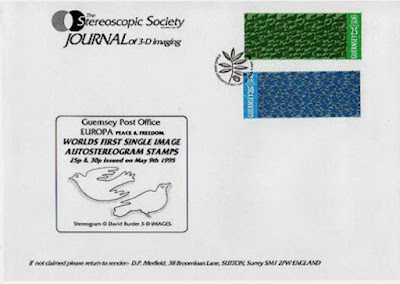
Autostereogram Stamps

Image
  An autostereogram is a two-dimensional (2D) image that can create the optical illusion of a three-dimensional (3D) scene. Autostereograms use only one image to accomplish the effect while normal stereograms require two.    The 3D scene in an autostereogram is often unrecognizable until it is viewed properly. One needs to stare at the scene for awhile for the 3D effect to emerge.   Guernsey Post issued a set of 2 stamps featuring design of a dove, a universal symbol of peace, one with a green background 25p stamp, and a blue background 30p stamp. Designed by Keith Bassford, the Autostereogram (a hidden image seen by crossing one's eyes in the correct way) was created by David Burder (UK) and Bob Mannle (USA). The hidden images are large versions of the doves as featured on the patterns i.e. on the 25p stamp the bird is standing, face to your right, while on the 30p stamp it is flying to the left.   Autostereograms can also be found in art. An example is by ren...

(___)Mentors on Stamps

Image
     To be published April 2030.......         Never surrender to any form of temptations that will taint your integrity - BBM