Posts

Showing posts with the label Medical

Gastroenterology on Stamps 2
Image
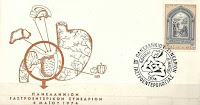
This is the second of the special series on Gastroenterology on stamps. Click here see first series. Featured here are the first day cover of the 3rd Panhellinic Congress of Gas troenterology issued by Greece in 1974, three special covers from Romania issued in 1993 for the National Symposium of Gastroenterology and Digestive Endoscopy, which had a special cancel and postmark and a Gastroenterology Week- Protection against AIDS stamp issued by Greece in 1992. In this connection, the PSDE C ommander General, Dr. Jonathan Sandejas is encouraging and inviting all gastroenterologist to join the 2011 Live Endoscopy Boot Camp and Workshop at NKI on August 17-19. Several GI topics will be tackled and "Meet the Masters" session is back.    Three international faculties from Singapore, India and Thailand will share their expertise. Hope to see you there.  I also hope and pray that medical businesses, hospitals and pharmaceutical companies will inculcate in their hearts pat...

Gastroenterology on Stamps

Image
Gastroenterology is the medical sub-specialty concerned with the function and disorders of the stomach, intestines, liver and related organs of the gastrointestinal tract. Endoscopy is a non-surgical procedure done by a gastroenterologist to look inside the gut using an endoscopic camera to diagnosis and perform therapeutic procedures like snare polypectomy (excision of pedunculated polyp), argon plasma coagulation (stoppage of bleeding), and rubber band ligation (esophageal varices). Some stamps related to Gastroenterology events had been issued. The majority are presented here. The World Congress of Gastroenterology (WCOG) is held every four years event under the auspices of the World Organisation of Gastroenterology (OMGE). Since its inaugural conference in 1958 in Washington, D.C.   WCOG has become the leading quadrennial gathering of the world's digestive disease physicians. The previous World Congresses where special stamps were issued for the event include- 1974 in Me...

Dr. Jose Rizal on Stamps

Image
José Protasio Rizal Mercado y Alonso Realonda (June 19, 1861 – December 30, 1896), was a Filipino polymath, nationalist and the most prominent advocate for reforms in the Philippines during the Spanish colonial era. He is the country's national hero and the anniversary of Rizal's death is commemorated as a Philippine holiday called Rizal Day. Rizal's 1896 military trial and execution made him a martyr of the Philippine Revolution. The seventh of eleven children born to a wealthy family in the town of Calamba, Laguna, Rizal attended the Ateneo Municipal de Manila, earning a Bachelor of Arts. He enrolled in Medicine and Philosophy and Letters at the University of Santo Tomas and then traveled alone to Madrid, Spain, where he continued his studies at the Universidad Central de Madrid, earning the degree of Licentiate in Medicine. He attended the University of Paris and earned a second doctorate at the University of Heidelberg. Rizal was a polyglot conversant in at least ten l...

Pio Valenzuela on Stamps

Image
Pío Valenzuela (July 11, 1869-April 6, 1956) was a Filipino physician and patriot who was among the leaders of the Katipunan that started the Philippine Revolution against Spain. Valenzuela City in northern Metro Manila was named after him. He wrote his memoirs of the Philippine Revolution in the 1920s, but historians have since been wary of his autobiography because of some inconsistencies in his version of events, particularly about his meeting with José Rizal in Dapitan in 1896. Valenzuela was the first mayor (American regime) of municipality of Polo (now Valenzuela City) from 1899-1900 before he became the governor of Bulacan province from 1921-1925. Valenzuela was born in Polo, Bulacan (Now Barangay Polo, Valenzuela City) to Francisco Valenzuela and Lorenza Alejandrino, who both came from wealthy families. After he was tutored at home, he was brought to Manila to study at Colegio de San Juan de Letran. In 1888, he enrolled at University of Santo Tomas and finished his Licenciad...

Mariano Ponce on Stamps

Image
Mariano Ponce (March 23, 1863 – May 23, 1918), was a Filipino physician, writer, and active member of the Propaganda Movement. In Spain, he was among the founders of La Solidaridad and Asociacion Hispano-Filipino. Among his significant works was Efemerides Filipinas, a column on historical events in the Philippines which appeared in La Oceania Española (1892-1893) and El Ideal (1911-1912). He wrote Ang Wika at Lahi (1917), a discussion on the importance of a national language. He served as Bulacan's representative to the National Assembly. Ponce was born in Baliwag, Bulacan where he completed his primary education. He later enrolled at the Colegio de San Juan de Letran and took up medicine at the University of Santo Tomas. In 1881, he traveled to Spain to continue his medical studies at the Unversidad Central de Madrid. There he joined Marcelo del Pilar, Graciano López Jaena and José Rizal in the Propaganda Movement which espoused Filipino representation in the Spanish Cortes and ...

Candido M. Africa on Stamps

Image
Dr. Candido Macasaet Africa (1895-1945) was a doctor of medicine, scholar and researcher. His contributions to medical science made him internationally known and won “for the first time recognition of the Filipino scientist abroad, thus reflecting glory and honor upon calling and country.” He was born in Lipa, Batangas on October 2, 1895. After graduation from the College of Medicine of the University of the Philippines, he taught at the Department of Parasitology, School of Hygiene and Public Health of the same college. He became associate professor and head of the department in 1932. It was while teaching at the state university that he became involved in scientific research. In all, he wrote 69 scientific articles, some of which he co-authored with his colleagues Walfrido de Leon, E.Y. Garcia, P.G. Refuezo, F.J. Dy, J. Soriano, J.O. Nolasco, S.F. Sta. Cruz and A.V. Vasquez Colet. Among his important works were “ The Progress of Medical Science In The Philippines,” “An Anthropod Asso...

Jo Magsaysay: Healing with Music and Medicine

Image
Whatever by Josefina "Jo" Gaboya Magsaysay Reprinted with permission from Sunstar Cebu August 31, 2006 issue   He was playing Mozart on the piano, his fingers caressing the keys like a lover. Piano was his first love, his first teacher was Anita Cabahug Trasmonte who rapped his wrists and knuckles to keep them in line. Be a doctor, his father, Engr. Vic (Evangelista-Auza- Garcia ) Avanzado, ( Talibon , Bohol ) told him, don’t be a musician. And because he was a good son, he obeyed his father.   Now Vicente B. Avanzado Jr . is a full-fledged doctor of medicine, in fact a fellow and a diplomate in Gastroenterology . Goodlooking with a smiling personality and yes, he still plays the piano. Beautifully. Music "relaxes and inspires" him and he believes "music and medicine are alike, both need continuous study and both can heal."    To celebrate Ting’s successful entry into the rarefied medical clique of fellows (he completed his fellowship at U.E. Ramo...

The National Anthem of Lithuania

Image
This former Soviet state was the first republic to break away from the Soviet Union, in early 1990. Upon its independence, it readopted the anthem, "Tautiska Giesme" , it first used in 1918 which first appeared in print in 1896. Vincas Kudirka , a Lithuanian poet and physician, and the author of both the music and lyrics of the Lithuanian National Anthem, Tautiška giesmė, was born on 31 December 1858. He is regarded in Lithuania as a National Hero. Kudirka used pen names - V. Kapsas, Paežerių Vincas, Vincas Kapsas, P.Vincas,Varpas, Q.D, K., V.K, Perkūnas. He began studying history and philosophy in Warsaw in 1881, but changed his major and began studying medicine the following year. During his studies, he was arrested as a subversive for having a copy of Das Kapital in his possession, and was expelled from the University of Warsaw, but later re-admitted. He graduated in 1889, and worked as a country doctor in Šakiai and Naumiestis. Kudirka began writing poetry in 1888. Simul...