Posts

Showing posts with the label Music Stamps from other Countries

Dominican Republic 2016 National Anthem 50th Anniversary

Image
On 7 June 1897, the Congress of the Dominican Republin passed an act adopting "Himno Nacional" with the original music and revised lyrics as the country's official national anthem; however, then President Ulises Heureaux (1846-1899) vetoed the act because the lyric's author, Prud’Homme, was an opponent of the president and his administration. In 1899, Heureaux was assassinated, and the political disorder that ensued prevented the national anthem's legal adoption until 30 May 1934 when "Himno Nacional" was officially adopted and signed into law. The Spanish name of the Dominican Republic, "República Dominicana", is never used in the anthem's official Spanish lyrics nor is the denonym for Dominicans, "dominicanos". Rather, the indigenous word for the island Hispaniola, "Quisqueya", is used twice and its derivative denonym, "quisqueyanos", is used once. However, research later shows that these ...

South African Anthem and Inauguration on Stamp

Image
Nkosi Sikelel' iAfrika was composed in the year 1897 by Enoch Sontonga, a Methodist school teacher. It was originally sung as a church hymn but later became an act of political defiance against the apartheid government. Die Stem van Suid-Afrika is a poem written by C.J. Langenhoven in 1918 and was set to music by the Reverend Marthinus Lourens de Villiers in 1921.[2] Die Stem was the co-national anthem[3] with God Save the King/Queen from 1936 to 1957, when it became the sole national anthem until 1995. The South African government adopted both songs as national anthems from the year 1994, when they were performed at Nelson Mandela's inauguration.[4] They were merged in 1997 to form the current anthem. The new English lyrics were adapted from the last four lines of the first stanza of The Call of South Africa (the English version of Die Stem), and were modified to reflect hope in post-apartheid South African society.

Guatemalan Anthem Lyricist on Stamps

Image
Written in response to a contest calling for a national anthem to be adopted, the first ever playing of the winning entry took place during a lyric-literary meeting taking place at the Colon Theater, the night of Sunday 14 March 1897, as one of the main events of the Central American Exposition, and the author of the music was decorated with a gold medal and honor diploma. (Ovalle had been known previously for setting to music "Himno Popular" (The People's Anthem) by the poet Ramón P. Molina. It is unclear whether the music used for Ovalle's work was the same as the music that was submitted for the national anthem competition.) The author of the lyrics, however, was submitted anonymously, it was not until 1911, when it was discovered that the author was the Cuban poet Jose Joaquin Palma, who on his deathbed was honored with a silver wreath placed on his head, while outside the public and the bands sang the Himno Nacional. The original lyrics were modified slight...

Isle of Man Anthem on Europa Stamps

Image
This is a Europa stamp featuring the lyrics of the anthem of the Isle of Man on the tab.  This set is compose of two stamps values of  25p and 30p.  Previously the anthem of the Isle of Man was already feature here .  The anthem composer and lyricist were shown in the stamp.  A Europa stamps are special stamps issued by European postal administrations under the aegis of PostEurop and which have Europe as their central theme. Europa stamps should underline cooperation in the domain of posts, particularly as regards the promotion of philately and contribute to making the public aware of common roots, culture and history of Europe and common goals." In 2002, more than 50 European countries and territories issued Europa Stamps. The first issue dates from 1956 with 6 countries participating. From 1993 all the stamps have "Europa" inserted into the design in small print. For the new millennium in 2000, the common design once more replaced the common theme. T...

Yugoslavian Anthem Lyrics and Score on FDC

Image
The National anthem of the Kingdom of Yugoslavia (Kingdom of Serbs, Croats and Slovenes 1918–1929) was created in December 1918 from the national anthems of the Kingdom's main three constituent historical provinces: Croatia, Serbia and Slovenia. In those times the official authorities considered the three nations, Croats, Serbs and Slovenes as one nation with three names. The official language was thus called the Serbo-Croato-Slovene language. Although a law on the national anthem did not exist, the anthems of all three South Slavic nations were unified into a single anthem of the Kingdom. It started with a few measures from the Serbian anthem "Bože pravde", continued with a few lines from the Croatian anthem "Lijepa naša domovino", which were in turn followed by a few lines from the traditional Slovenian anthem "Naprej zastava slave". The anthem finished with some lines from the Serbian anthem again. It was officially used between 1919 and 1941...

The 20th Anniversary of the Restoration of State Independence of the Republic of Azerbaijan on Stamp and Souvenir Sheet

Image
Like other republics of the Soviet Union at the time, Azerbaijan had its own anthem, which was in use until shortly after the fall of the Soviet Union in 1991. Azerbaijan was originally given an anthem in 1944, but a slight change to the lyrics came in 1978 with the removal of Stalin's name and other minor changes. The composer of the anthem's melody also wrote the music for the current Azerbaijani national anthem in 1919 before Azerbaijan became part of the Soviet Union. On January 30, 1920, the Azerbaijan government announ ced a competition to create a national anthem, but in the result of the fall of Azerbaijan to the Soviet Union on April 28, 1920, the anthem was not adopted. On May 27, 1992, after the breakup of the Soviet Union, the "Azerbaijan Marsi," which was created in 1919 during the brief independence period, was approved as the State Anthem of the Republic of Azerbaijan . The composer of the anthem was Uzeyir Hajibeyov, the s...

Iranian Anthem Composer, Ruhollah Khaleqi, on Stamp

Image
On July 11, 2011, Iran issued a stamp on musician and composer Ruhollah Khaleqi known for his composition of Iran’s former national anthem "O, Iran". The stamp, printed in commemoration of the musician, was unveiled during a ceremony held on the side section of Iran’s National Orchestra performance in the presence of Iranian tar virtuoso Hossein Alizadeh.Khaleqi was brought up in a family of music lovers. He was a student of celebrated composer and musician Ali-Naqi Vaziri.His other credits include several books on music under the titles “History of Iranian Music” and “A View on Iranian Music.” Rūhollāh Khāleqi (1906, Kerman, Iran – November 12, 1965, Salzburg, Austria) , also spelled as Khaleghi, was a prominent Iranian musician, composer, conductor and author. Ruhollah Khāleghi was born in Mahan, a small town near Kerman, in a musically minded family. He first became acquainted with the tar, but later started to learn to play the violin. As soon as Ali-Naqi Vaziri establ...

The Anthem of Taiwan on Metered FDC

Image
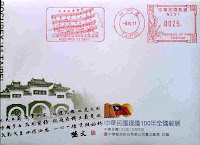
This is the First Day Cover of 2011 ROCUPEX Taipei Stamps Exhibition Meter Stamp from Formosa (Taiwan), Republic of China. The 2011 ROCUPEX Taipei Stamps Exhibition commemorates the 100th anniversary of the Republic (Oct 07-12,2011).    This FDC, issued on October 7, 2011 features the image of National Anthem of the Republic of China . This cover is a design error with 2 wrong Chinese characters in the National Anthem of the meter stamp. The special meter shows the score of the National anthem.   The anthem lyrics in traditional Chinese script is seen on the cachet. This FDC has a face value of 25 new Taiwan dollar.

Rota- Anthem of the Polish National-Territorial Region

Image
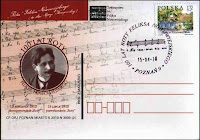
The Polish National-Territorial Region (Polish: Polski Kraj Narodowo-Terytorialny) was an autonomous region in Lithuania, self-proclaimed by the local Poles on 6 September 1990. The region included areas surrounding Vilnius, capital of Lithuania, where Poles formed the majority (60–90%). This Eastern part of Lithuania had been part of Poland (from 1922) before being attached to Lithuania under the Mutual Assistance Treaty with the Soviet Union in 1939. The autonomy region with capital in Naujoji Vilnia included 4,930 km² and population of 215,000 (66% of them Poles). The Polish autonomous movement was related to the Yedinstvo movement and had tacit support from Moscow (thus, when following the Act of the Re-Establishment of the State of Lithuania the Soviets applied a blockade against Lithuania, the areas of Eastern Lithuania with significant minority population were mostly spared of the blockade, with the aim of gaining minorities' support for Moscow). In the region, the Polish Re...

The New National Anthem of Libya

Image
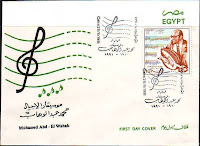
Libya, Libya, Libya (also known as Ya Beladi, "Oh my country!"), composed by Mohammed Abdel Wahab , is the new national anthem of Libya. He also composed the music for the anthems of Tunisia and the United Arab Emirates. The anthem was used until the monarchy was abolished in a coup by Moammar Qadaffi in 1969, when it was replaced with a new anthem. It was originally the national anthem from independence in 1951 until 1969 when King Idris I was overthrown by a Coup d'état led by Muammar al-Gaddafi. Gaddafi adopted the Egyptian marching song Allahu Akbar (God is Greatest) as the national anthem of the newly proclaimed Libyan Arab Republic. The anthem was a Muslim call to prayer and a statement of faith composed by Abdalla Shams El-Din and lyrics written by Mahmoud El-Sherif. During the 2011 Libyan civil war, Libya, Libya, Libya was declared the new national anthem and restored by the transitional government. Above is a first day cover of the Libyan anthem composer Moham...

The National Anthems of India and Bangladesh on One Miniature Sheet

Image
Rabindranath Tagore (7 May 1861 – 7 August 1941) was a Bengali polymath who reshaped Bengali literature and music. Author of Gitanjali and its "profoundly sensitive, fresh and beautiful verse", he was the first non-European Nobel laureate. His poetry in translation was viewed as spiritual, and this together with his mesmerizing persona gave him a prophet-like aura in the West. His "elegant prose and magical poetry" remain largely unknown outside Bengal. A Pirali Brahmin from Kolkata, Tagore had been writing poetry since he was eight years old. At age 16, he published his first substantial poetry under the pseudonym Bhanushingho ("Sun Lion") and wrote his first short stories and dramas in 1877. Tagore achieved further note when he denounced the British Raj and supported Indian independence. His efforts endure in his vast canon and in the institution he founded, Visva-Bharati University. He also wrote and composed the National Anthems of India and Ban...

50th Anniversary of the Swiss National Anthem on Stamp

Image
Until the end of the 19th century, there was no Swiss national anthem . The German-language patriotic song Rufst du, mein Vaterland, composed in 1811 by Johann Rudolf Wyss (1743–1818), was the first national anthem, used until 1961. The Swiss Psalm was composed in 1841 by Alberich Zwyssig (1808–1854), with lyrics by Leonhard Widmer (1809–1867). Since then it has been frequently suggested it be adopted as the official anthem, but the Swiss Federal Government has refused several times, wishing to let the people decide what they want to sing on political and military occasions. The setting of the hymn to the British tune of God Save the Queen led to embarrassing situations when both countries' anthems were played. Therefore it was replaced with another tune in 1961. After a trial period of three years the Swiss tune was adopted indefinitely in 1965. The statute could not be challenged until ten years later but did not totally exclude the possibility of an ultimate change. A competiti...

The 2011 PPO Season Concert VIII: Poom and Mahler I

Image
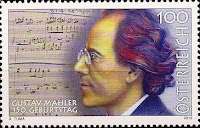
For the closing concert of the 28th concert season of the Philippine Philharmonic Orchestra, at the Cultural Center of the Philippines (CCP) theater, Maestro Olivier Ochanine and the orchestra welcome pianist Poom Prommachart, 1st Prize winner in the 2010 Isidore Bajik International Piano Competition to perform Rachmaninoff's 3rd Piano Concerto. Also on the programme, which rounds up Maestro Ochanine inaugural season with the orchestra, the First symphony of Gustav Mahler will be performed. Mahler was nearly thirty years old by the time he finished his very first symphony, and the work shows musical maturity and expertise at orchestration quite well. This work is a rousing finale for the end of the Philippine Philharmonic Orchestra season. Gustav Mahler (7 July 1860 – 18 May 1911) was a late-Romantic Austrian-Bohemian composer and one of the leading conductors of his generation. As a composer, he acted as a bridge between the 19th century Austro-German tradition and the mo...

Spyros Samaras, Olympic Hymn Composer

Image
Spyridon-Filiskos Samaras (also Spyros / Spiro Samara) (17 November/29 November 1861 Corfu – 25 March/17 April 1917 Athens) was a Greek composer particularly admired for his operas who was part of the generation of composers that heralded the works of Giacomo Puccini. His compositions were praised worldwide during his lifetime and he is arguably the most internationally lauded Greek composer before Dimitri Mitropoulos. As a young man Samaras studied with Spyridon Xyndas in Corfu. From 1875-1882 he studied at the Athens Conservatory with Federico Bolognini, Angelo Mascheroni and Enrico Stancampiano. His first opera Torpillae (now lost) premiered in Athens in 1879. He went to Paris in 1882 to study at the Paris Conservatoire and became a favorite of Jules Massenet. His other instructors included Léo Delibes, Théodore Dubois, and Charles Gounod. He worked successfully as a composer in Paris for three years and then migrated to Italy in 1885. Samaras quickly became an important figure in ...

The National Anthem of Malaysia

Image
Before independence in 1957, each of the (then) eleven states of Malaysia had their own anthem (which they have retained to this day), but there was no unifying anthem for the whole country. When independence was approaching, Tunku Abdul Rahman , then the Chief Minister and Minister for Home Affairs (later Malaysia's first prime minister), led a committee to select a new anthem.    Hundreds were recieved, but none were deemed suitable. Finally, the anthem for the Malaysian state of Perak was considered, and the melody, due to its "traditional flavour" was selected to be the melody for the new anthem. In 1888 the Sultan of Perak was invited by Queen Victoria as a guest. When the Sultan's aide was asked what the anthem of Perak was, so that it could be played upon his formal arrival, the aide, not wanting to be embarrassed by saying that Perak did not have an anthem, perhaps giving the impression that his country was "backwards", proceeded to hum a favouri...

Anton Pann on Stamp and Postal Stationary Envelope

Image
Anton Pann is generally believed to have authored the music to Deşteaptă-te, române!, Romania's national anthem . His associate Gheorghe Ucenescu is known to have arranged the melody to the lyrics of Andrei Mureşanu , but Pann's direct implication in the creative process was allegedly not confirmed by sources. According to one account, Ucenescu had used a romanza composed by Pann in 1839, in turn complimenting the lyrics of Grigore Alexandrescu. It has also been argued that the music was that of a popular lied (German song), and first published in one of Pann's manele collections. The ethnographic research carried out by Dimitrie Gusti confirmed that the same melody was being sung as a folk song by Southern Dobrujan ethnic Turks in the 1930s.    Mihai Eminescu, one of Romania's most influential poets, made a reference to Pann in his poem Epigonii (1870), which, in its opening verses, traces the development of early literat ure and the impact of Romanticism. Cited alon...

The UPAEP Symbols Series 2010- The Anthem Stamp Issuing Countries

Image
Several countries issued a postage stamp based on the theme of National Symbols, the topic for last years (2010) UPAEP series. Most of the stamps issued depicts, flags, national emblems, plants, animals, etc. Some of the countries which issued their national anthem on stamps and these include Suriname , Brazi l , Cuba , Uruguay , Paraguay and Ecuador . The Postal U nion o f the Americas, Spain and Portugal (UPAEP) , based in Montevideo, Uruguay, is an association of postal authorities of following countries: Netherlands Antilles, Argentina, Aruba, Bolivia, Brazil, Canada, Chile, Colombia, Costa Rica, Cuba, Ecuador, El Salvador, Spain, USA, Guatemala, Haiti, Honduras, Mexico, Nicaragua, Panama, Paraguay, Peru, Portugal, Dominican Republic, Surinam, Uruguay, Venezuela. It was founded in 1 911 as a restricted union of the Universal Postal Union. Since 1989, the UPAEP member countries are issuing sets of stamps based on a common theme, which always included the logo of the organization....

The UPAEP 2010 Series: The National Anthem of Paraguay

Image
"Paraguayos, República o muerte!" (Paraguayans, The Republic or Death!) is the National anthem of Paraguay. The words were written by Francisco Esteban Acuña de Figueroa and music composed by Francisco José Debali . The anthem was adopted in 1846 and officially declared in 1934. Paraguay's anthem is a classic example of a "Latin American epic anthem". The seven verses of the anthem also resemble other nations' anthems of this type, for example, the first three verses of Paraguay's anthem, recalling its history and specific events, is very similar to the theme of Honduras' anthem, whereas the fourth verse which praises the national symbols, and the last three verses, which are a call to patriotism, are common themes in these type of anthems. Paraguay's second anthem (the first, written solely in the native Guarnaní language, was adopted in 1831), it was adopted in 1846 and was officially declared as the national anthem in 1934 after the final r...

The UPAEP Symbols Series 2010- The National Anthem of Ecuador

Image
"¡Salve, Oh Patria!" ("We Salute You, Our Homeland") is the national anthem of Ecuador. The lyrics were written in 1865 by the poet Juan León Mera , under request of the Ecuadorian Senate; the music was composed by Antonio Neumane. However, the anthem was not officially adopted by the Congress until September 29, 1948. In 1865, the Argentine musician Juan José Allende, in collaboration with the Ecuadorian Army, preseented to the National Congress a musical project for the lyrics by José Joaquín de Olmedo, but it was not well received. In November of this year, at the express request of the president of the Senate, Nicolás Espinosa, the Ambateño poet Juan León Mera Martínez, who was then the secretary of the Senate, wrote and submitted the lyrics of the National Anthem. These lyrics were then sent, with Congressional approval, to Guayaquil, so that Antonio Neumane would set them to music. This is the hymn that would later be officialized as the definitive national a...

The UPAEP Symbols Series 2010: The National Anthem of Cuba

Image
El Himno de Bayamo (The Bayamo Anthem) is the national anthem of Cuba. It was first performed during the Battle of Bayamo in 1868. Perucho Figueredo , who took part in the battle, wrote and composed the song. The melody, also called La Bayamesa, was composed by Figueredo in 1867. On October 20, 1868 the Cuban forces obtained the capitulation of the Spaniard authorities in Bayamo, the jubilant people surrounded Figueredo and asked him to write an anthem with the melody they were humming. Right on the saddle of his horse, Figueredo wrote the lyrics of the anthem, which was longer than the current official version. Figueredo was captured and executed by the Spaniards two years later. Just before the firing squad received the Fire command, Figueredo shouted the line from his anthem: Morir por la Patria es vivir. Officially adopted in 1902, the anthem was retained after the revolution of 1959. The arrangement commonly used, without credit in Cuba, is believed to be that of José Norman, auth...