Posts

New Zealand's Unofficial National Anthem on Stamps?

Image
New Zealand has honored Engelbert Humperdinck by releasing a stamp based on his song ‘Ten Guitars’. Engelbert released ‘Ten Guitars’ as a b-side in 1967. It was also on his debut album ‘Release Me’. However, despite originally be used as more filler than thriller the song took on a life of its own in New Zealand and is now considered the country's unofficial national anthem.    There was even a Facebook petition to have it made the national anthem. ‘Ten Guitars’ is said to be one of the most played songs at parties in New Zealand.The 60-cent ‘Ten Guitars’ stamp features in a set of Kiwiana stamps out now in New Zealand. Engelbert Humperdinck (born Arnold George Dorsey; 2 May 1936) is a British pop singer, best known for his hits including "Release Me (And Let Me Love Again)" and "After the Lovin'" as well as "The Last Waltz" ("The Last Waltz with You").   email: vincemd3069@gmail.com

The 20th Anniversary of the Restoration of State Independence of the Republic of Azerbaijan on Stamp and Souvenir Sheet

Image
Like other republics of the Soviet Union at the time, Azerbaijan had its own anthem, which was in use until shortly after the fall of the Soviet Union in 1991. Azerbaijan was originally given an anthem in 1944, but a slight change to the lyrics came in 1978 with the removal of Stalin's name and other minor changes. The composer of the anthem's melody also wrote the music for the current Azerbaijani national anthem in 1919 before Azerbaijan became part of the Soviet Union. On January 30, 1920, the Azerbaijan government announ ced a competition to create a national anthem, but in the result of the fall of Azerbaijan to the Soviet Union on April 28, 1920, the anthem was not adopted. On May 27, 1992, after the breakup of the Soviet Union, the "Azerbaijan Marsi," which was created in 1919 during the brief independence period, was approved as the State Anthem of the Republic of Azerbaijan . The composer of the anthem was Uzeyir Hajibeyov, the s...

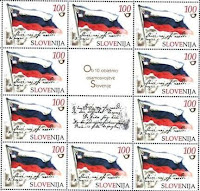
Slovenian Anthem Lyrics on Stamps

Image
"Zdravljica" was written by France Prešeren , considered as Slovenia's national poet, as a drinking song (in his original manuscript, the layout of the words resemble a wine glass), but also was seen as politically charged piece when it was written in 1844 as it spoke of pan-Slavic nationalism, which was controversial in Austria-Hungary (which Slovenia was part of at the time). It was finally published in 1848, after revolutions in Austria-Hungary lifted the censorship. In 1905, Zdravljica was set to music for the first time, the entire poem had a choral composition composed for it by Stanko Premrl, and this was the composition chosen as the Slovenian anthem in September 1989. Six months later, it was specified that the seventh verse is the official anthem, and this remains to this day. The block above contains the flag and some of the lyrics of the Slovenian national anthem. It was issued on 2001 .

Qin Shi Huang's Teracotta Army in Xian

Image
Some Chinese scholars labelled Emperor Qin Shi Huang as a tyrannical megalomaniac who ordered the killing of his writers and philosophers and burned books written about previous kings and rulers so that Chinese history begins with him. But these seemingly evil ways ironically resulted into today's magnificent structures (Great Wall) and discoveries. One of these great discoveries were Emperor Qin's Terra-cotta army. These thousand-years-buried treasures are located about 1.5 kilometers east of the Emperor QinShihuang's mausoleum, symbolizing the main defending force that guarded the capital before Emperor Qin died. These soldiers were to accompany him in the afterlife. Until today, no one has seen the Emperors body due to the elaborate network of traps and poisons (mercury) he designed while he was alive. The Terracotta soldier were never mentioned in the historical records until Pit 1 (first exc avated area) was discovered in March 1974 by local Chinese farmers while...

THE FDC COVER FOR SOKOL CONVENTION PRAGUE 1948 WITH CZECHOSLOVAK ANTHEM

Image
This cover was published in Czechoslovakia in 1948 for its 11th SOKOL Convention. "SOKOL" is a sport organization, Czechoslovak Sokol Community and Prague Sokol were played an important role by events around the foundation of the Czechoslovak Republic. This FDC includes 4 special overstamped stamps with the text:" PRAGUE 1948 Nationwide SOKOL Convention". On the cachet, we can see the words and music of Czechoslovak Anthem "Where is My Home" in Czech language. The size of the cover is 22 x 11 cm / 8.6 x 4.3 inches. The FDC Cover for SOKOL Convention Prague 1948 with Czechoslovak Anthem and for occasional stamps.

'O Canada' on the 2011 Canadian Flag Definitive Stamps Series

Image
The sheer number of places where the Canadian flag is found was the creative impetus to this stamp series. According to Liz Wong, Stamp Design Manager for the series, the challenge was to take a very common but much beloved image like the flag, an image people are familiar with seeing on a stamp, but approach it in a fresh new way and present the flag in ways in which it’s actually used. “The Canadian Pride series draws your attention to both the common – and uncommon – places the flag appears.” The five Permanent domestic stamps in this year’s issue demonstrate both personal and official appearances of the flag; on a traveller’s backpack, a hot air balloon, the Canadarm, and both a Canadian soldier’s and a search and rescue expert’s uniforms. The stylized “O” (for “O Canada”) not only acts as a symbol of the national anthem, it also serves as a means of focusing attention on the flag and its surroundings. Liz Wong adds that “by framing the visual with the “O” of “O Canada”, this stamp...

Iranian Anthem Composer, Ruhollah Khaleqi, on Stamp

Image
On July 11, 2011, Iran issued a stamp on musician and composer Ruhollah Khaleqi known for his composition of Iran’s former national anthem "O, Iran". The stamp, printed in commemoration of the musician, was unveiled during a ceremony held on the side section of Iran’s National Orchestra performance in the presence of Iranian tar virtuoso Hossein Alizadeh.Khaleqi was brought up in a family of music lovers. He was a student of celebrated composer and musician Ali-Naqi Vaziri.His other credits include several books on music under the titles “History of Iranian Music” and “A View on Iranian Music.” Rūhollāh Khāleqi (1906, Kerman, Iran – November 12, 1965, Salzburg, Austria) , also spelled as Khaleghi, was a prominent Iranian musician, composer, conductor and author. Ruhollah Khāleghi was born in Mahan, a small town near Kerman, in a musically minded family. He first became acquainted with the tar, but later started to learn to play the violin. As soon as Ali-Naqi Vaziri establ...