Posts

Thang Long Imperial Citadel in Hanoi
Image
The Imperial Citadel of Thang Long is the cultural complex comprising the royal enclosure first built during the Lý Dynasty and subsequently expanded by the Trần, Lê and finally the Nguyễn Dynasty. The ruins roughly coincide with the Hanoi Citadel today.    The royal palaces and most of the structures in Thang Long were in varying states of disrepair by the late 19th century with the upheaval of the French conquest of Hanoi. By the 20th century many of the remaining structures were torn down. Only in the 21st century are the ruin foundations of Thang Long Imperial City systematically excavated. The central sector of the imperial citadel was listed in UNESCO's World Heritage Site on July 31, 2010 at its session in Brazil. Remains of the Imperial City were discovered on the site of the former Ba Đình Hall when the structure was torn down in 2008 to make way for a new parliament building. Various archaeological remains unearthed were brought to the National Museum to be e...

The Majestic Halong Bay in Vietnam

Image
Ha Long Bay is a UNESCO World Heritage Site, and a popular travel destination, located in Quang Ninh province, Vietnam. Administratively, the bay belongs to Hạ Long City, Cẩm Phả town, and part of Van Don district. The bay features thousands of limestone karsts and isles in various sizes and shapes.   Ha Long Bay is a center of a larger zone which includes Bái Tử Long bay to the northeast, and Cát Bà islands to the southwest. These larger zones share similar geological, geographical, geomorphological, climate, and cultural characters. Ha Long Bay has an area of around 1,553 km2, including 1,960–2,000 islets, most of which are limestone. The core of the bay has an area of 334 km2 with a high density of 775 islets.    The limestone in this bay has gone through 500 million years of formation in different conditions and environments. The evolution of the karst in this bay has taken 20 million years under the impact of the tropical wet climate. The geo-diversity of the envir...

Cebuano Abstract Expressionism

Image
Abstract expressionism is the term applied to new forms of abstract art developed by American painters such as Jackson Pollock , Mark Rothko and Willem de Kooning in the 1940s and 1950s. It is often characterised by gestural brush-strokes or mark-making, and the impression of spontaneity Within abstract expressionism were two broad groupings: the so-called action painters , who attacked their canvases with expressive brush strokes; and the colour field painters who filled their canvases with large areas of a single colour. Wenceslao “Tito” Cuevas (September 2, 1938 –March 19, 2012), a renowned third generation Cebuano artist, whose non-conformist attitude paved the way for Filipino modern art to emerge in the Queen City of the South . He is regarded as the Father of Cebuano Abstract Expressionism Cuevas exposed himself to art outside the Philippines. "This exposure paved way for his signature abstract expressionist style. Splatters of paint and bold brush strokes done...

Anthem Covers with Special Postmarks

Image

Wuzhen- The "Venice of the East"

Image
Wuzhen , a 1300 year old water town on the lower reaches of the Yangtze River, is a national scenic area and one of China’s top ten historical and cultural towns. It is also one of China’s most charming towns. Located on the Hangzhou-Jiaxing-Huzhou Plain in north of Zhejiang Province , it is at the center of the golden triangle consisting of Shanghai, Hangzhou and Suzhou . Wuzhen is easily accessed through a number of expressways and national highways. The ancient Beijing-Hangzhou Grand Canal flows through the town, which is divided by waterways into four areas, Dongzha, Xizha, Nanzha, and Beizha. Since its foundation in 872 A.D., Wuzhen has never changed its name, location, waterways, or way of life. Its traditional buildings have survived hundreds of years of weathering but remain intact today. In 2001, Wuzhen was named as a candidate for UNESCO’s World Cultural Heritage List. At the end of 2006, it was included in the revised List of China’s Candidates for UNESCO World Cultura...

De Young Museum at Golden Gate Park

Image
The de Young Museum, also known as the M. H. de Young Memorial Museum, is a fine arts museum located in San Francisco's Golden Gate Park. It is named for early San Francisco newspaperman M. H. de Young. The museum opened in 1895 as an outgrowth of the California Midwinter International Exposition of 1894 (a fair modeled on the Chicago World's Columbian Exposition of the previous year). It was housed in an Egyptian style structure which had been the Fine Arts Building at the fair. The building was badly damaged in the earthquake of 1906, closing the building for a year and a half for repairs. Before long, the museum's steady development called for a new space to better serve its growing audiences. Michael de Young responded by planning the building that would serve as the core of the de Young Museum facility through the 20th century. Louis Christian Mullgardt, the coordinator for architecture for the 1915 Panama-Pacific International Exposition, designed the Spanish-Plate...

Exploratorium of Fine Arts in San Francisco

Image
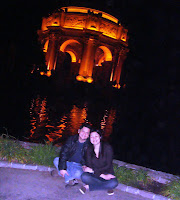
The task of creating a Palace of Fine Arts for the 1915 Panama-Pacific International Exposition fell to the architect Bernard R. Maybeck, then fifty years old and known for his innovative ideas. Setting to work on this new project, he chose as his theme a Roman ruin, mutilated and overgrown, in the mood of a Piranesi engraving. But this ruin was not to exist solely for itself to show "the mortality of grandeur and the vanity of human wishes .... " Although it was meant to give delight by its exterior beauty, its purpose was also to offer all visitors a stimulating experience within doors. In playing host to the Panama-Pacific International Exposition, The Fair, which opened on February 20, 1915, San Francisco was honoring the discovery of the Pacific Ocean and the completion of the Panama Canal; it was also celebrating its own resurrection after the shattering earthquake and fire of 1906.   The problems of choosing the exact site in the city had finally been overcome a...